Tuesday, July 16, 2013

Rattled by Routes and Rain: Game 78 in Wisconsin

Routing headaches and traffic miseries rarely had worried me on our way to ballparks, partly because of Toad’s maneuverability, partly because of Bonnie’s access to web reports about different directions, and partly because I insisted on having an arrival cushion that often deposited us at ballparks well before my scheduled pregame meeting with staff.  

In San Antonio road construction in the heart of the city had prompted us to Google an alternate route to the Missions’ ballpark, only to find that we had been directed to an authentic San Antonio mission on the opposite side of the city.  Even so, we made it to the baseball park a half hour before the game’s start, exactly at the time I was scheduled to meet the game-day staff.  Approaching New Orleans, we had learned that the causeway over Lake Pontchartrain was clogged or closed, prompting us to take a more circuitous approach that still gave us plenty of time to get to the Zephyrs’ ballpark.  The miracle of iPad access allowed us to circumvent clogs in Birmingham and Gwinnett.  Yet in Massachusetts while Arby still had Toad tethered, we found no escape from the freeway repair that kept us inching along for more than an hour, a pace so slow and with unpredictable end that we worried about reaching Lowell in time for the Spinners’ doubleheader. 

Not since that Northeast construction delay had I worried about getting to a game on time, especially having budgeted extra hours for driving from the northern Chicago area to Appleton, Wisconsin on a Saturday.  But my anticipated three-hour drive eventually doubled in length, causing me to fret most of the miles.  Since Bonnie had taken a weekend leave from ballgames to join a women’s (non-baseball) retreat on the Rock River, I could not rely this time on her navigational trouble-shooting with her iPad.
The woes unfolded in this way: From the RV park in Volo to Appleton, the most direct route coursed like a crooked river over county roads, which, on a weekend, I feared might be slowed with tractors and farmers and in-laws reluctantly heading to remote reunions.  So instead, I turned east, not north, heading toward Lake Michigan and the I-94 corridor between Chicago and Milwaukee.  I hoped to capitalize on its regular freeway flow on an innocuous Saturday in July.

To get to the Interstate, however, I had to drive through several villages and towns crouching toward Lake Michigan.  Approaching Grayslake around noon, I ran into traffic backed up on the single lane of Route 120 and waited through three changes of the traffic signal before I could move through the intersection at Milwaukee Road.  I probably should have heeded the omens of the travel deities at that point and turned north.  Yet, I persisted in my direction toward Lake Michigan. 

Rather than being relieved when I reached the Interstate, I thought that I had returned to L.A., seeing that its traffic was at a standstill.  Not wanting to chance that the clog might be temporary, I continued on 120 to U.S. 41 North, not far beyond the freeway and there found an easy flow toward the Wisconsin border a dozen miles away.  But a few minutes later, an orange sign alerted me to construction and delays on 41 North as it merged with I-94.  While a smaller sign marked an alternate 94 to the right, I naively persisted in my move toward the freeway ramp until the traffic stopped.  Luckily, a gravel lane crossing-over the grassy median provided a means to escape, and I U-turned around toward Illinois 173, which was identified as the alternate 94 route. 

Alas, the traffic backed up right away on 173 because of a one-lane bridge with restricted flow controlled by another traffic signal.  Delayed by two red lights in that construction, I was relieved to resume normal speed momentarily for about a mile before having to stop in the line waiting for a freight train to clear the road’s crossing.   Once it had passed and the arms blocking the tracks had lifted, traffic accelerated in its flow to the posted limit.  

What else might impede my progress, or lack thereof, I wondered, since I had come less than 20 miles in the first hour of an anticipated three-hour drive?  I didn’t have to think long.  Ahead, police action—merely a traffic citation being issued to a motorist—constricted traffic to a single lane before I could turn north on Illinois 131, approaching the Wisconsin state line.    Yet one more kind of delay: Some event was being held there at the stadium near the crossroads, and traffic clotted yet again with turning vehicles slowing to pay for parking while pedestrians—some daringly darting, others ambling unconcerned—across my path.

Four miles later, I finally felt deliverance as I entered Wisconsin, finding its highways wide, clear, and without potholes.  I didn’t even mind that there were partial barriers on I-94 as I approached Milwaukee and made my way through downtown since traffic there slowed only moderately. 

Beyond Milwaukee, I drove in clear skies above Highway 41 until I reached the Oshkosh area, where I could see dense storm clouds to the northwest.  I hoped that I would be spared another rainout since there was a chance that the ballpark might lie south of the storm line that was perceptibly moving toward the northeast. 
The field was sheltered under the tarp while I was sequestered in Starbucks.
At a few minutes after 4:00 I finally reached the Appleton exit for the Timber Rattlers’ ballpark and noticed flags briskly slapping toward the east.  I looked heavenward, to no avail—other than noting the imminence of the approaching storm.  Yes, at 4:20 the downpour—that’s putting it mildly—began while I sat in Starbucks, sipping coffee and starting to write about the day’s delays and frustrations and worrying anew about whether I would get to sing that evening.  Mid deluge, my hope started to slip like the person sloshing and sliding through the parking lot, finally spilling his coffee, not into a puddle but into his SUV.

For almost two hours the skies emptied time and again with arpeggio flourishes.  But after 6 o’clock, the thunderheads started to break as I splashed in Toad toward the Timber Rattlers’ ballpark a mile or so away.   What an incredible surprise!  Despite the intensity and duration of the thunderstorm, hundreds of fans had already convened for parties in the parking lot, setting up tailgate barbecues. 


Perhaps they knew that the Timber Rattlers’ promotion for that night was an umbrella give-away to the first thousand fans entering the ballpark!
The umbrellas came in handy while raindrops persisted.
Although Charleston and Durham had deeper outfield pools and more splash spots behind home that required removal before their games, I hadn’t seen players assist the grounds crew in sweeping water away until T. J. Mittelstaedt, the Rattlers’ starting left fielder, picked up a broom and began to clear puddles in the dugout.  
Outfielder T.J. gets an odd pregame assist.
During the game I also saw a play that I hadn’t seen before.  In the second inning, Wisconsin pitcher Matthew Miller, perhaps rattled by Burlington runner Yordy Cabrera’s break from first, dropped to the ground to avoid the catcher’s throw to second, which never came. 
Miller ducks the unthrown throw.
Other “firsts” also distinguished my experience at Appleton’s
Fang himself.
ballpark, whose concessions featured several unique snacks and drinks.  I guess that I shouldn’t be surprised that Wisconsin was the only place where cheese curds were available.  Another unusual offering from the grill was “Fang’s Venom Burger,” dressed with hot spices, peppers, salsa, and cheese, although it was made with beef rather than rattlesnake.  And two of the micro brews adopted complementary serpentine names: Snake Tail Ale and Rattler Brau Scottish Ale.  Similarly, the team store picked up on the herpetological motif, identifying itself as the “Snake Pit.” One can only imagine its merchandizing possibilities, especially novelties associated with the team mascot Fang.

Fox Cities Stadium also featured fan interactivity via smart phones.  By accessing www.rattlersingame.com, fans could order concessions to be delivered directly to their seats, and they could play various rattler games, post ballpark pictures, provide twitter feeds and link Facebook posts.  Socializing more immediately were groups in the Picnic Pavilion.  While various wedding celebrations occasionally had been held at other Minor League ballparks, the picnic area at the Rattlers’ ballpark simultaneously hosted three distinct wedding groups on this last Saturday in July: Bridget’s Bachelorette Party, the Geiser and Knier Wedding Party, and Dave Selan’s Bachelor Party.  One can only hope that specially ordered cakes were appropriately delivered to each group.
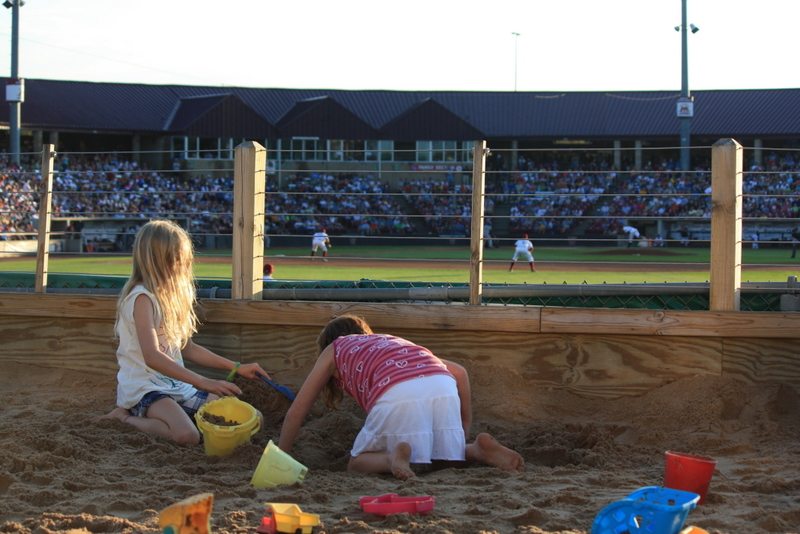
Other gathering spots included the berm along the right field line and the sandbox beyond the centerfield fence.  With so many activities supplementing the baseball game, it’s no   wonder that, despite the rain, the ballpark sold out for the game.
Despite the wet hillside, fans spread out below the Bunyanesque big chair.

After finishing the final notes of the anthem, I detoured past puddles in front of the Rattlers’ bench, and  their third base coach applauded my rendition, calling out, “Good job!”  Since he had heard me sing when the Timber Rattlers had struck the Loons in Midland at the beginning of the week, he added, “Are you following us?”  Then Wisconsin had won handily, 6-3.  But this night the venom of the Rattlers couldn’t match the sting of the Bees from Burlington, which won 8 to 2, thanks in large part to a bases-loaded double and a two-run homer by A. J. Kirby-Jones.


Monday, July 15, 2013

Chicago Promotions: Game 77 in Kane County

Once Bonnie had decided to join me in the cross-country journey in Arby, I wanted to make sure that we could be in the Chicago area at end of July for her birthday.  She loves to visit friends in the city where we spent a decade during my graduate studies.  And since art, not baseball, is one of her passions, Chicago also lures her with the Art Institute and its adjacent Millennium Park.   

When we arrived in suburban Chicago three days before her birthday, we anticipated a couple of tourist days before and after my appearance with the Kane County Cougars, the only Minor League team within earshot of a Harry Caray homerun call at either Wrigley Field or US Cellular Park.  When we have returned to Chicago, we usually have stayed with friends on the South Side or at one of the hotels near the river or on the Miracle Mile.  But with Arby to care for, we selected an RV park north suburban Volo, a location near one of the commuter rail lines to the Loop and within a few miles of a truck repair shop where we had scheduled a mechanic to replace the bushings on our bouncing beast Arby. 

Thus far throughout our trip—to our great surprise—we had found that few of the RV parks where we stayed were peopled with RVers on the move.  Most were locations where permanent RV residents lived, as in Fayetteville, Arkansas, which had a single space unoccupied by “long termies”; or they were primarily vacation locations, like the park in Wales, Massachusetts, where most of the sites were set up as summer second homes.  Sometimes they were simply destinations for mutli-day stays, such as the Zooland Park in Ashboro, North Carolina, which was near the North Carolina Zoological Park and the Potter’s Museum in Seagrove, an oddly named community hundreds of miles from the nearest shore.  Yet few parks had been like near Memphis and Fort Wayne, ones that we had expected to find more frequently: easily accessible, adjacent to the freeway, with plenty of pull-through sites.  Our place at the Fish Lake Beach RV Park in Volo fit the vacation home category:  Of the 550 sites there, 90% were permanently docked motor and mobile homes for weekend and summer escapes for folks in the Chicago vicinity.

Throughout the week before our arrival there, record-breaking heat had blanketed the upper Midwest, making afternoon and early evening games miserable. The Chicago area greeted us with a different weather threat.  Throughout the night thunderstorms raged and the downpour continued past the second pot of morning coffee.  Finally as the storm started to break, our site resembled the shallows of Fish Lake itself.  Puddles had swelled into ponds.  
Boys bike through the rain while Arby and Toad remain on dry ground.
Concerned that my Kane County appearance might be rained out, I began to wonder whether Ann Lindner, one of our Chicago friends who planned to join us for the game that evening, might be a thunderstorm jinx.  A month earlier she had coordinated her family’s vacation to Washington, DC to correspond with my schedule for singing for the Potomac Nationals.  But that game had been rained out by a microburst that deluged the municipal park, unprepared for drainage. 
Even Nationals' staffers had used umbrellas at Potomac in the covered concession area.
Several calls to the Cougars’ front office assured me that the evening game would proceed as scheduled. Even so, I hoped that there would be at least one shift from the guidelines that the Cougars’ anthem coordinator had sent to me received several weeks earlier.  They included the recommendation that I should purchase my tickets early.  Hmm.  Purchase tickets?  For several ballparks along the way I had been warned that I would need to pay for parking—a fee that was waived by appreciative lot attendants on all but two occasions—but no team had suggested that I would need to pay for entry to the game for which I would sing.

#45's pants near the entry.
So when we neared Elfstrom Park in Geneva 35 miles south of Arby’s mooring, I took the late afternoon sunshine as a brilliant omen.  Walking toward the ticket office I noticed the pants of a Cougars’ player hanging from a branch in the tree near the exit from the home team clubhouse.  While the sunshine might have been a good omen, I didn’t know how to interpret the half-scarecrow of trousers: Had #45 been found guilty in the Cougars’ kangaroo court?  Or did the dangling pants portend me getting pantsed during my tickets request?  Warily, I approached the Will Call window and identified myself as the anthem singer, indicating that Assistant General Manager Jeff Ney had set things up as part of my national tour.  Twisting her mouth to the right side and raising her eyebrows, the Cougars’ staffer then shrugged a little, handing me three tickets, probably in Ney’s box since they were in the first row behind the backstop.

Bonnie and Ann relax in front row seats.
To a certain extent Minor League baseball attracts fans in relation to the promotions that are offered.  Each Wednesday at Kane County, attendees receive a “Winning Wednesdays” scratcher, which might offer a discount on a featured concession, tickets to a subsequent game (my ticket),

or the chance to throw out a first pitch (like that of the young boy who proudly claimed his opportunity while I talked with the promotions staffers). 
A winning first pitcher!
During the game, an upcoming celebration of promotions was also promoted.  The extravaganza would feature 100 different promotions offered throughout the game, and it would spotlight Nancy Faust (the Chicago sports organist extraordinaire who accompanied me at old Comiskey Park in 1977 when I first sang the national anthem for a baseball game) and Mike Veeck (son of the promotional innovator Bill Veeck, part owner of five Minor League teams, and the person who set up my initial singing for the White Sox).  Mike himself is also an inventive promoter, once having arranged for a pig to deliver baseballs to the home plate umpire and on another occasion having offered fans a chance to receive a therapeutic massage from a Roman Catholic nun.  I only wished that I could hang around Kane County long enough to attend the Cougars’ promotional festival and witness the shenanigans that might be in store.

In a different way I also experienced a promotion at the ballpark.  On the announcement board along the concourse behind home plate, the Cougars had posted an article from the Kane County Chronicle about my appearance at Elfstrom Stadium.  Standing nearby while I read and photographed the piece was its author, Kevin Druley, who had talked with me several days earlier following a feature that had run on The University of Chicago’s website. 
The posted version of Druley's piece. 
That story had also prompted an interview with Manya Brachear, a reporter for the Chicago Tribune who sent Nuccio Dinuzzo, one of the newspaper’s staff photographers, to record my rendition that evening so that it could accompany her story the following day
.  After Jeff Ney saw Nuccio shooting my performance, he expressed a shocked delight that the Trib was finally noticing the suburban Cougars.  “I’ve tried over and over to get them just to print our scores,” he bemoaned, “and they always ignore us.  How did you get them to come out here?”

While the publicity about my appearance at Kane County was unusual, there were
The entry gates to Elfstrom Park.
customary displays and experiences at Elfstrom.  Like several other Minor League ballparks, current Major Leaguers and former team stars were recognized.  On the awnings above the entry to Elfstrom, action images of Cougar alumni Josh Beckett, Joe Blanton, Ryan Dempster, and Adrian Gonzalez greeted fans. 
And inside the ballpark former Cougar catcher Charles Johnson was recognized by his retired number—35—the only one so honored by the team.  Twice a first-round draft pick (initially by the Montreal Expos after graduating from high school and then by the Florida Marlins in 1992 while he was finishing his collegiate career at the University of Miami), Johnson slugged 19 homeruns and collected 94 RBIs for Kane County in 1993, his first season as a pro.  Within two years, he was playing regularly for the Marlins, and during his twelve-year Major League career, he won five Gold Glove awards and twice was named to the All-Star team.  Since both Josh Beckett and Adrian Gonzalez wore 19, I’d expect that number to be the next one retired by the Cougars.

Like clusters of fans at a number of other parks, a quartet of regulars—Sue, Dan, Pam, and Judy—sat in a shady set of seats behind the backstop and congratulated me when I walked up to the concession stands.   They commented specifically on my tone, pace, and articulation, as well as the fact that I appeared to enjoy singing the anthem. 
Dan, Pam, Sue, and Judy
Dan had attended games in about 100 ballparks, and Judy enjoyed watching her grandson play for the Cougars.  They let me know that they regularly grade anthem performances; and so I asked about my score: a 93, a low A, a grade that fits with the low A level of the Midwest League.  Curious about how my rendition might rank with others that they had heard, I inquired about distinct anthem performances that they recalled.  While they assured me that they would remember mine favorably because of my tour and our conversation, they squinted as shook their heads, recounting only several face puckering ones with sour pitch that they had heard throughout the season.

The game itself also caused the hometown fans to cringe during a seventh-inning disaster.  After starting pitcher Yordano Ventura and reliever Antonio Cruz shut Cedar Rapids down following a first-inning run, the Cougars’ seventh-inning pitchers created distress rather than relief, allowing three singles, issuing three walks, adding a wild pitch, and permitting the Kernels to score four times, enough to assure the visitors’ victory 6-3.

Sunday, July 14, 2013

A Loony Christmas Tune: Game 76 in Midland, MI


Months before I had hummed the starting pitch for my first rendition on the anthem tour, I had mapped out possible routes for connecting sites, minimizing mileage, and maximizing landscape beauty and other passing attractions.  While trying to figure out how I could pass through areas of the country that I had not previously seen, I had tried to align consecutive games in Midland, Michigan, where the Great Lakes Loons make their home, with other teams in the Midwest League.  And because I had never been to Michigan’s Upper Peninsula, I had hoped that it would be possible to aim Arby north from Midland, cross the bridge to Mackinaw Island, loop through the U. P., and then descend through Wisconsin to Appleton for a Timber Rattler’s appearance.  Although that route might exceed my daily target for mileage, I figured an extra night between games would be worth the northern exposure.   And if the trek north couldn’t be navigated, then taking Arby and Toad on a ferry ride across Lake Michigan from Ludington to Manitowoc, just an hour’s drive from Appleton, might be equally adventurous.

Alas, neither schedule could be worked out.  Meanwhile, Midland didn’t seem to lie along a route to anywhere, much less half way to somewhere—thus confounding the appropriateness of its name “Midland.”  Even so, I set up a date with the Loons following a game in Lansing and two days before one for the Kane County Cougars in suburban Chicago.


So while Bonnie and I headed north in Toad from the comforts of the Cottonwood RV Park in Lansing, I wondered if Midland would be worth our jaunty spur since neither the Mackinaw route or the Lake Michigan crossing had become feasible.  Added to my concerns was the fact that the Midland team enjoyed the support of Dow Chemical,
whose home office and primary plant are in Midland!  As an ardent supporter of ecological initiatives, I could hardy fathom appreciating the alignment of the Loons with Dow.  Yet few teams, ballparks, and cities proved as receptive, supportive, and innovative as Midland.  And it also enjoyed alignment with one of my hometown teams, the Dodgers, as their Low-A farm team.


The Loons' tribute to Lasorda, who appeared at the ceremonies announcing the Loons' affiliation with the Dodgers.

Often, staff members who escorted me during the pre-game ceremonies were unaware of my anthem project, and some had to request my name, which occasionally had been omitted from the day’s flow chart of pre-game activities.  More than two dozen times, I was introduced simply: “Tonight’s national anthem performed by Joe Price,” with no mention of my affiliation with Whittier College while first pitchers and dream team players received more extensive introductions.   On a number of occasions, staff greeted me appreciatively and graciously; and Midland led the league in this category. 

The credit for such incredible hospitality must go to Linda Lones, the game-day staff member who coordinated my visit.  
Linda Lones and me
During the staff gathering before the gates opened, she informed ushers and game-day entertainers about my tour while emphasizing the evening’s theme of “Christmas in July.”  The meeting ended with a cheer, and the staff, appearing jubilant like carolers, dispersed to their respective duties, many stopping to welcome me and thank me for including Midland on the tour.

Familiar with positive experiences that I had written about in my blog, especially the fun at Altoona where she had worked the previous year, Linda indicated that she wanted to do something special to distinguish my visit to Midland; so she proposed that I throw out the first pitch, an opportunity that I had not been offered at any other ballpark.  Moments before the anthem, then, I joined Santa on the mound and threw a pitch over the heart of the plate—but on a single bounce! 

Thankfully, my delivery of the anthem went without a hitch. Then for only the second time all tour, the home team manager—John Shoemaker— approvingly stopped me and handed me an autographed ball.  Fans also expressed their appreciation in more typical comments: “Thank you for your project.”  “What you’re doing is good.”  “Thanks for coming to Midland.”

Kuo's bobble-head bounced happily in Arby.
After I joined Bonnie in the stands, Linda appeared with Santa sacks filled with Loons loot: T-shirts and blankets, trinkets and candies, and two bobble head dolls, both from earlier promotions—one of Michigander Kirk Gibson and the other of former Loon and then Dodgers pitcher Hong-Chi Kuo.  When we returned to Arby later that evening, we mounted the mini-Kuo on the shelf above the door to the RV, letting him function like old St. Christopher statuettes mounted on dashboards of sturdy station wagons.

Modeling yuletide joy, staff members wore Christmas ties and tucked Santa hats into their belts.  Their merriment extended to the introductions of the Loons whose representations on the scoreboard featured the winter holiday theme by using a candy-cane font to identify uniform numbers.  When right fielder Nick Akins came to bat, he was depicted as St. Nick with a white beard and Santa’s cap.  At the plate, Akins experienced a game like Christmas, getting on base in all five plate appearances, slapping two singles and working three walks.  

And other Loons joined him in the Christmas hit parade: doubling was “Cold” David Iden, who was represented in ice attire; and singling were John Garcia, who was portrayed in an elf costume, and lumbering first baseman Chris Jacobs, who stole no bases during the entire season, but nonetheless appeared as “the Grinch who stole Christmas.”

Despite the scoreboard’s festive portrayal of the Loons, the game itself featured umpires almost as much as players.  In top of the sixth inning after a close play at the plate, the home plate ump, Dane Ratajski, tossed the Loons’ catcher Michael Pericht who argued the call. 
Ratajski, Seneca, and Peritch during the calm of pre-game ceremonies.
And in the next inning Ratajski ejected designated hitter Bobby Coyle after striking out.  While it’s not uncommon for a player to argue a called third strike, nor even a checked swing, I had never seen a player tossed after swinging and missing strike three.

Not to be out argued by Ratajski, base umpire Mario Seneca blew two calls, prompting protests before reversing his rulings:  With runners on first and second and none out, Iden hit a soft liner to the edge of the infield grass in front of the shortstop.  Too low for the infield fly rule to be called, the Wisconsin infielder snared the ball on a short hop while the runners, thinking it would be caught on the fly, returned to their bases.  The shortstop tossed the ball to the third baseman, who tagged the base, forcing the runner who had retreated to second.  Then he threw the ball to the second baseman, who tagged second and the base-runner, standing on the bag, just to make sure.  Finally, he threw the ball to first, where the runner had crossed the base and stood with his teammate who had retreated. 

In the confusion of runners and throws, Seneca called a triple play, and the Rattlers left the field.  Iden, meanwhile, was instructed by the first base coach to stay on first—alone.

Shoemaker argued mildly, asking Seneca to consult with Ratajski, the home plate ump.  He did.  After they sorted through the sequence of tosses and tags, Iden was ruled safe and the Timber Rattlers returned to the field to record a different final out of the inning.

I still haven’t seen a triple play in person.

In the next inning Seneca blew another call, another based on familiarity with the rules rather than simply a judgment decision, like calling a strike, a balk, or an out on a bang-bang play.  This was the situation: With a runner on first and none out, Wisconsin’s batter bunted down the first base line, fielded by the first baseman who made a sweeping tag attempt on the hitter.  Seneca called him safe.  Again Shoemaker argued and asked for him to confer with Ratajski, who ruled correctly that the batter had been out for swerving out of the base runner’s lane.  The score: Shoemaker 2, Seneca 0.

As magnetic as were the plays and calls in the game and as gracious as was the reception of my appearance by staff and fans, the experience in Midland was made even more engaging by the character of the Loons’ organization and the architecture of the ballpark.  While some Minor League teams like the Arkansas Travelers are community owned, the Great Lakes Loons are unique in their ownership by a non-profit, public charity, the Michigan Baseball Foundation.  At the end of each baseball season, the Foundation awards its year-end balance to various Midland and mid-Michigan charities.  And the previous year’s donations had exceeded a hundred thousand dollars.

The salutary mission of the organization was also reflected in the ballpark’s design and facilities.  Built on the site of the original headquarters for The Dow Chemical Company, the stadium was completed in 2007 in time for the Loons’ inaugural game after the purchase of the Southwest Michigan team and its move from Battle Creek.  In that initial year, the Dow Diamond won Baseball Digest’s award for the Best New Ballpark. 

The organization and the ballpark are the only ones that I encountered with a thorough commitment to sustainability, evinced by their pledge to cut their water, waste, and energy use by half in the next decade.   For starters, the huge video board is powered by more than 150 solar panels installed adjacent to the park’s right field gate.  (Although there is no direct connection between the panels and the scoreboard, the energy annually generated by the solar system basically equals that required for the video board’s operation.) 
The park of panels beyond the right field wall.
Manifesting its ecological initiative in a different way, the ballpark’s construction crew crushed and repurposed the red brick salvaged from the original Dow complex for use in the warning track.


A distinct ballpark design element also enhanced the Christmas in July promotion: a grand fireplace dominates the intersection of the main entry and the concourse, allowing stockings to be hung by the chimney with care.
 

And adding warming possibilities to the ballpark in another way, two fire pits on the terraces promise to lure Loony fans on cold, early season evenings—hardly the situation on the 90-plus degree day when we were there.   
Loons' staffers Eric and Shelley stay warm without the benefit of the fire pit.
All said, you gotta love the Loons, even though they lost 6-3 to the Wisconsin Timber Rattlers.


Loons' staffer Emily provides a yuletide wave.
 

Thursday, July 11, 2013

Old(s) and New: Game 75 in Lansing

Leaving the RV park in Auburn, Indiana just north of Fort Wayne early Sunday morning, we headed three hours north to Lansing, Michigan, old home of the Oldsmobile factory (until 2004) and still home of the Lansing Lugnuts.  Initially named Oldsmobile Park for the oldest brand of American automobiles, Lansing’s relatively new ballpark, built in 1996, oddly stands as a kind of relic to the automotive industry since it witnessed the demise of the trademark car’s manufacture within less than a decade following its construction.  Now the ballpark is legally known as the Cooley Law School Stadium
—a paradox, of sorts, since Cooley Law School, which purchased the naming rights, doesn’t field any athletic team.  Even so, the ballpark’s old Olds name is a cherished one, and one emblazoned in my memory. 
For the decade preceding its death, Olds had promoted a television ad campaign that featured a slogan designed to appeal to a new generation of prospective Olds owners: “This is not your father’s Oldsmobile.”  But that is exactly what the car had been, my father’s Olds 88, a cherished gift in 1963 from the church that he had pastored for almost twenty years.  And, yes, it was the car in which I learned to drive and the one on which I put door dents and side scratches during the first weeks of my license. 

Although I had never been to Lansing, the name of its ballpark evoked the deep sense of satisfaction that the 88 had prompted decades earlier.  Completed in anticipation of the inaugural season for Lugnuts, Oldsmobile Ballpark hosted its very first game between Big Ten, in-state rivals Michigan and Michigan State, with the Wolverines winning an extra-inning decision by a single run over the Spartans.  About the time that the nearby factory towed the last Olds off the production line, renovations to the adolescent Oldsmobile ballpark were completed, and various fan pit stops in the ballpark assumed names aligned with the automotive industry and its products.  The picnic porch was designated as Gasoline Alley, and the souvenir store was tagged as Nuts and Bolts,

while the hot dog and burger stand—the Chrome Plated Grille—crouched under the hood of the grandstand’s canopy. 


Although the concession stands adopted automotive names, they didn’t thematize their super-size snacks with names like a “trunk full of fries” or a “tank of tea.”  Even so, they did toss a change-up toward the down-home favorite of a fried bologna sandwich, which they distinguished by serving the seared and warped deli slice on a toasted waffle bun.  Yet it's too bad that they didn't label that snack as a tire tread delight.
As usual I arrived at the ballpark well before game time, indicating to the parking lot attendant that I was the anthem singer and asking where I should park.  “Not here unless you have a printed pass,” he offered.   “But you can park in that space while you go to the office to check on the availability of a pass.”  I did.  And there I learned that all of the lot’s spaces were designated for the day.  “So where should I park?” I asked Nick Grueser, the Assistant GM who was working at the Will Call window.  “In a metered space on the street,” he replied, “since parking is free on Sundays.” Then shoving a five-dollar bill into my hand, he added, “If you can’t find a spot nearby, this should cover the charge of one of the lots across the street.”
Michigan's Capitol
 
Welcomed by Nick’s gesture, I smiled at the attendant as I exited the small reserved lot, turning right toward the State Capitol perched above Main Street less than a mile away.  Toad hopped into the first open spot about a block away, prompting the return of the five-spot to Nick a few minutes later. 
 
The walk back to the ballpark was surprisingly stimulating.  Several sidewalk sculptures and brilliant banners, which had been installed as part of the City’s Street Exhibition, remained on display.  Nearest the ballpark’s entry was a welcoming and intriguing installation, “C’ood: a democracy experiment” by Margaret Parker.  Airy and interactive, the colorful sculpture invited fans and even passersby to detour through its space to see the Lansing world and sky through its steel-laced portals.   


Margaret Parker's inviting "C'ood"
Also welcoming fans to the ballpark were memorial and tribute bricks interspersed throughout the walkway leading to the main entrance.  Curious about who might be honored with sentiments, I paused and found a grandchild’s tribute to “Clare Warner—1880-1953/Grandpa Loved Baseball”; and the simple affirmation, “Friends of Joe,” offered by “Le Legion du Lugnuts.”
Before Lansing, Sunday afternoon games had produced several unpredictable spiritual expressions.  At my first Sunday afternoon game in Fort Myers three months earlier, I had witnessed a genuine act of grace when an eight-year-old girl dashed for a foul ball bouncing through the box seats, retrieved it gleefully, and then gave it to a disappointed pre-school aged boy whom she had beaten to the prize.  Weeks later at a Sunday game in Mississippi, muted recognition of the Christian Sabbath was ironically displayed: while the public address announcer acknowledged several church groups attending the game, the primary evidence of its being Sunday was the closure of the Chick-Fil-A concession, a corporate policy to permit employees to join their families for worship, and the pre-game singing of “Amazing Grace” by a choir from a secular school.  And prior to the Sunday game in Asheville, I heard—for the only time on my tour—a public invocation delivered from behind home plate before my singing the National Anthem.
Yet in Lansing, Sunday manners and patterns appeared more typical, even if more secluded than in the previous ballparks.  In the undercroft where I was taken to warm up or wait without distraction for the pre-game ceremonies, a sign on the door to the Lugnuts’ lockers invoked silence and respect: “Chapel in progress.”  Minutes earlier, Baseball Chapel had concluded its home-game Sunday Bible study and meditation under the leadership of two chaplains, both members of Lansing’s South Church.
Rolando Quiroga had led the Spanish language Bible lesson, focusing on the challenges of sexual temptation and biblical teachings about resisting temptation.  Although members of the visiting team often participated in the Sunday services, none from Beloit had joined the four Lugnuts and ballpark staff members who had attended this morning.  While Rolando had conducted the Bible studies for Spanish speakers, seminary student Jeremy Focu had led an English language devotional.  In his first year serving as a leader for Baseball Chapel services, Jeremy was in the process of assuming the mantle of his father-in-law, who had served as Lansing’s chaplain since the team had been founded.  On this morning Jeremy focused his message on the epistle to Titus, emphasizing the need to exercise control over temptations.
By the time that I entered the locker room, a single Lugnuts’ staffer remained talking with Rolando Although I take seriously the performance of the anthem as a kind of patriotic consecration of the game, I delayed my usual vocal exercises until I noticed that Big Lug, Lansing’s mascot standing nearby, did not distract their discussion as he playfully donned his silly purple costume that featured big bolts as nostrils on his mask.  Then I was distracted—and inhibited—by trying to warm up adjacent to Big Lug.
Often at Single-A ballparks, interns who escorted me to field had little interest in the anthem or my tour. 
Gabe appears in a different kind of screen test.
By contrast, Lansing staffer Gabe Esquivel inquired about my singing of the anthem game after game, each with different settings, procedures, and acoustics.  She acknowledged that earlier in the season she had already performed the anthem at a Lugnuts’ game as a last minute replacement.  Hours before a performer had been scheduled to appear, she had received a call to pinch sing.  
The most memorable part of her experience, she recalled, was that she had rehearsed her rendition in the car while driving to the ballpark. 

At Lansing, my rendition a short time later continued a week’s run of stellar performances in my estimation; and my evaluation was confirmed by a vacationing Methodist minister who remarked on my performance as “crisp and undecorated,” as she put it, “making it possible for all to join in, like a congregational hymn.”  That’s success—because it’s our national anthem, not my theme song, however I might be associated with it.
During the fourth inning a carefree kid abandoned his ball and glove, shoving them under the bench a row or so behind his grandfather Leonard Burns, who angled back toward the boy’s stuff while I focused my camera on the innocent equipment.   
Assuring him that I was simply photographing the deserted gear, I enjoyed another serendipitous encounter, learning that he had been on Whittier’s campus.  When he had served as the superintendent of Bellflower Schools near Los Angeles, Dr. Burns had attended the inauguration of Eugene Mills as President of Whittier College a few years before I joined its faculty.
At most minor league ballparks, a roster of players who have on stage in “The Show” is prominently displayed, and often banners or posters throughout the concourse celebrate current major league stars who played for the home team.  At several of the ballparks, there are team “halls of fame”—bronze plaques or photographic exhibits that identify the most outstanding players of bygone years.   At Salem, Virginia, an elaborate “hall” stood adjacent to the miniature Fenway replica that featured a little Green Monster where children played Wiffle ball.
At Lansing there was a different pitch for its few Hall of Fame inductees, who included Carlos
Beltran and Carlos Zambrano, current, accomplished Major Leaguers.  Also celebrated by Lansing with Hall of Fame honors was Brian Dopirak, a former Lugnut inducted in 2010 after toiling in the Minors for almost a decade.  The impressive thing is that, after eight years playing primarily for small-town teams, he had not yet sipped a cup of coffee in the big leagues.  Still, he was honored because in 2004 he had set Lansing records for HRs and RBIs in a season—39 and 120—also socking 38 doubles while batting .307.  Now having risen for a full season to AAA, I saw him in a single plate appearance for the Oklahoma City RedHawks when they had lost two months earlier to the Nashville Sounds, also on a Sunday.  Alas, then he carried a .259 average into the game and walked as a pinch hitter in the 6th inning.
In this game between the Lugnuts and Snappers, no plays or players stood out other than the Lugnuts’ starting pitcher, Marcus Walden, who departed with a win after five strong innings of one-hit ball, only to see the Snappers chomp the lead to a single run before the home team held on for a 6-4 victory.