Monday, May 21, 2012

Who's Intimidated? Game 45 in Kannapolis


After starting a North Carolina week in the Smokey Mountains before spending several days along the stretch of I-40 from Durham to Winston-Salem, I turned back toward the Charlotte area where Kannapolis provided my final stop in the state.  During my Tar Heel tour I had sung for teams in the Carolina League, the International League, the Eastern League, and the South Atlantic or Sally League (as it was popularly known some years ago).  And if the Appalachian League had begun its short season schedule by this time, I would have added another team or two.  Burlington had approved me to sing; but, alas, they wouldn’t begin play for another two weeks.
In sequence: Asheville, Charlotte, Hickory, Greensboro, Winston-Salem, Durham, Kannapolis.
Simply and thoroughly, I resonate with the Tar Heel region, not merely because of its baseball skeleton.  While I love the landscape—the comforting haze snuggling down among the Blue Ridge mountains and the hardwood forests hugging the rolling hills—I get inspired by the state’s traditions of folk art, its celebration of multiple musical styles, and its passion for sports.  In fact, I could easily have been a North Carolina native.   My oldest sister was born in this state while my father had been on the faculty at Meredith College in Raleigh.  But before I was born he left the professorate to assume a pastorate in Mississippi, from whence my roots spread more easily to his deep, deep family ties in Western Kentucky.

Across its varied terrain, a sporting spirit characterizes the Tar Heel state, especially during spring and summer.  The spring’s sports-obsession begins with ACC basketball and March Madness, which almost always features Duke or North Carolina in the Final Four, not to mention that NC State, Wake Forest, and Davidson excel in roundball.  And NASCAR’s circuit, which revs up with the Daytona 500 shortly before the NCAA basketball playoffs, traces its roots and rapid growth to the mountain regions of North Carolina, for whom the stock car fascination provides its pulse.

As much as Daytona, Darlington, and Bristol lure racing fans to desirable NASCAR destinations, Kannapolis in North Carolina is probably the true Mecca for the most fervent stock car devotees.  For it was in this historic mill town dominated by the textile industry that Dale Earnhardt was born, and throughout surrounding Cabarrus County dozens of NASCAR teams have their headquarters.  It should not be too surprising that the Kannapolis minor league team is known as the Intimidators, taking their name from Earnhardt’s moniker.

It is fitting, then, that one of the Intimidator’s race cars—a “Number 3” black Chevy donated by the Earnhardt Foundation—guides most fans from the parking lot to the front gate at the Fieldcrest Cannon ballpark, so named to recognize the historic significance of the textile magnate for the area’s economy. 

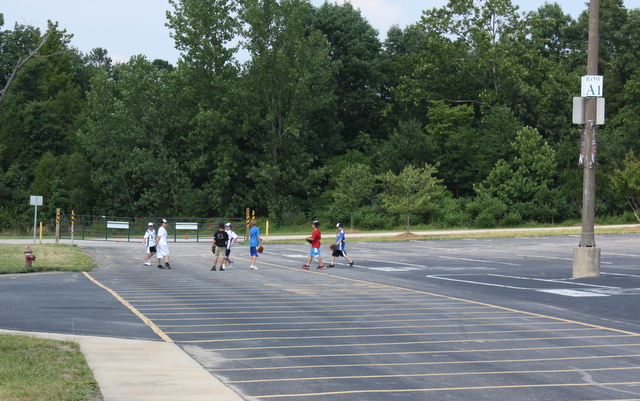
Despite the move of most fans toward Number 3, other young fans found a remote corner of the parking lot to their liking for a game of catch, exercising their own pre-game warm-ups. 
While NASCAR certainly dominates the region, North Carolina still enjoys a summer love affair with baseball.  The state was the home of Enos “Country” Slaughter and Catfish Hunter, Hall of Famers among the hundreds of Tar Heel players who have become Major League all stars, and it routinely boasts the most varied slate of minor league teams of any state.  If you count Charlotte’s Knight’s among the North Carolina teams—the Knights actually play their home games a few miles south of the state line in South Carolina—the state features nine affiliated minor league franchises, fielding teams in all five levels of minor league play.
During childhood, I enjoyed learning about geographic regions by locating clusters of teams in aptly named leagues like the New York-Penn League or the Texas League or the South Atlantic League.  But since Kannapolis was set to play the Delmarva Shorebirds, whose home is in Salisbury, Maryland, I cringed at the geographic conflict between the team’s location and the League’s historic identity.  Even so, the acceptance of a team from Maryland’s eastern shore in the so-called South Atlantic League is less egregious than the League’s inclusion of the Lakewood Blue Claws, whose northerly home in New Jersey at least peers toward the Atlantic, while the League’s landlocked Lexington Legends’ home ballpark is a two-hour flight from the nearest ocean shore.

The discomfort of my final Carolina afternoon was not caused simply by Sally’s geographic indifference.  Kannapolis tried to intimidate the Shorebirds with such hot and humid conditions that even Earnhardt’s Number 3 sweated profusely, or so it appeared since its black skin glistened like a middle-reliever facing a clean-up hitter with the bases loaded and none out.  Other than the gleaming black shell of Earnhardt’s Chevy, the most impressive aspect of the ballpark happened to be the men’s restroom, which features nineteen urinals, twelve stalls, and a dozen sinks; alas, despite that name of the ballpark, there were no hand-towels with labels from Fieldcrest or Cannon.
The miserable conditions of the afternoon were further intensified by the bleating sun that blistered all but two rows of seats directly in front of the press box; so I sought pre-game refuge in the air-conditioned gift shop where I resisted feeling intimidated by the barrage of team souvenir possibilities. 
While the grounds crew finishes pre-game prep, fans huddle in the only shade near the press box.

Leaving the comfort of the air-conditioned space, I made my way to the field where I needed to tiptoe past the dugout littered with tobacco wads.  Although Minor League Baseball forbids the use of tobacco products on the field, the dugout lip was stained with tobacco spit.  Even so, this was North Carolina, home of Tobacco Road and a different kind of Lucky Strike.  Awaiting the start of pre-game ceremonies, Intimidators play hackey-sack with baseballs, with the added challenge of keeping the pristine balls out of the the chaw debris. 


Kannapolis pitcher Dexter Carter and then takes time to learn new shooting techniques from team photographer Ray Marsden.

Nearing the half-way point in my anthem tour, I was surprised by two previously unheard comments about my project and performance from Intimidators’ personnel, while I was also reassured by a fan offering the most common response about my style.  I had grown somewhat accustomed—but still frustrated—to my frequent, minimal introduction, like today’s, as “Joe Price.”  Without the simple recognition of my affiliation with Whittier College or a brief description of the anthem tour, I often had found that ballpark staff members were unaware of my anthem efforts.  Especially in those cases I tried to inform the on-field host about the team’s participation in the project. 
Perhaps the fans thought that I was this "Joe"!
At Kannapolis, the pre-game staff’s ignorance about my project was most glaring.  Andrea, the anthem staff facilitator, was astonished to learn about my progress in singing the anthem at more than 100 minor league ballparks.   “All this season?” she queried.  “Have you got the dates set?”   I was dumbfounded.  How could she possibly comprehend the project since it had taken more than 300 hours work in the previous year to contact teams, secure approval from senior staff members, develop feasible routes, propose fitting dates, and confirm acceptance—all before driving the first mile in Arby or singing the first anthem in Florida.
The other comment was more affirming: As I walked past the Intimidators’ dugout after singing, manager Julio Vinas called out, “Good job again!”  Three days earlier he had heard me sing the anthem when the Intimidators had visited Greensboro, where they had stomped the Grasshoppers 9-3.  Today’s outcome would be even more decisive.  Perhaps Julio would like for me to intimidate their opponents more often!

Making my way then up the aisle behind the dugout, I was stopped by “Red,” a season ticket holder whose head of hair was fierier than the afternoon sun.  While I was making my way quickly toward the little shade, he grabbed my arm to make sure I heard: “Thank you, Joe.  Nothing funny, the way it’s s’posed to be.”

And that’s the way Kannapolis played baseball that afternoon: nothing funny; the way it’s supposed to be.  In the bottom of the first inning, the Intimidators certainly sought to exemplify their name.  Already leading 2-0 thanks to back-to-back doubles with two outs, Kannapolis placed runners on the corners.  While Delmarva’s pitcher Timothy Berry was coming to his set position in the stretch, Juan Silverio broke from third and slid across home plate before Berry could make a play.  But because Rafael Vera, the Kannapolis runner on first, tried a delayed steal of second, Berry whirled and threw to the shortstop, who nailed Vera before he reached the bag.  Although Silverio scored before Vera was tagged out, Silverio was not credited with the rare steal of home, which he had seemingly accomplished without a play.  

The mascot seemed more lovable than intimidating.
Like Silverio, the Intimidators’ starting pitcher Matthew Heidenreich did not get full credit for his season-best performance.  By the top of the fifth inning, the Intimidators had built a 9-0 lead.  But an out later, they were threatened, not by the flock of Shorebirds from Delmarva, but by rain.  A violent thunderstorm swept through the area, halting play for almost an hour.  During the downpour Heidenreich headed to the showers in the club house, thus losing his chance for a win in what would have been his five minutes and two outs later.  In more than four strong innings, he had given up a harmless single and a lone walk.  But because of the downpour before the end of the opponent’s fifth, he would go unrecognized with “no decision.”

While the grounds crew scurried to cover the field, I retreated past Earnhardt’s memorial and headed north back to Arby docked near Ashboro, driving Toad through intermittent driving rain that slowed traffic on Interstate 85 to the pace of a caution lap on a NASCAR track.
Former Intimidators who also made their way north on I-85, all the way to the Show.


Friday, May 18, 2012

Almost Shut Out: Game 43 in Durham

By twenty-four hours, I missed seeing Dirk Hayhurst hurl a shut-out for the Durham Bulls at home on Tobacco Road.  Normally, Hayhurst wouldn’t seem to warrant special notice since he was not a highly-rated Minor League prospect even though twice he had brewed a pot of coffee in “the Show.”  In 25 appearances for San Diego and Toronto in 2008 and 2009, he had struck out 27 batters in 40 innings, failing to win either of his two decisions.

But Hayhurst is noteworthy as an author—not of pitching gems but of books.  Beginning in 2007, Hayhurst became a diarist for Baseball America’s website, honing his writing skills as he reflected on the routines and challenges of a Minor Leaguer.  His 2010 book, Bullpen Gospels: Major League Dreams of a Minor League Veteran, achieved the all-star status that he had dreamed about when it became a New York Times best-seller. 

In the book Hayhurst avoided the polar temptations to expose teammates in clubhouse shenanigans or to sentimentalize his seasons in the sun.  Instead, he explored the enduring lure of baseball while revealing his struggles with daily necessities and routines, all the while celebrating his good outings and acknowledging his failures.  Shortly before I started the anthem tour, a friend had given me the book, which I inhaled.  It’s lively, entertaining, and poignant.  Having the chance to see Hayhurst in action would have been more than a minor (league) highlight.

Like the Lehigh Valley Iron Pigs who had scratched out a single hit in their scoreless effort against Hayhurst the night before, I too was threatened to be shut-out in Durham—not by a pitcher, but by torrential rain. 
The crowd gather as the gates open.
When Bonnie and I arrived at the ballpark almost two hours before game time, we were surprised by the density of the crowd and the impossibility of parking, even in little Toad, not big Arby.  Although I had been warned that I’d need to find parking on my own, I circled through the nearby streets, found no spaces, and finally drove toward the attendant at the entry to the small team lot.  Rolling down my window I inquired rather innocently, “I’m the anthem singer tonight.  Where should I park?”  Looking befuddled for a second or two, he waved me past his check point and into the reserved spaces.  With that good luck, I anticipated an auspicious evening. 


Tribute to former Major League pitcher and manager Roger Craig.
The weather was warm, and the crowd jazzed about evening promotions featuring former Durham Negro League players as well as two dozen Boy Scouts troops.  Walking toward the Will Call Window, Bonnie and I paused to read names and tributes in the memorial bricks adjoining the ballpark.  
In addition to markers identifying the affiliations of Durham’s minor league teams over the years, another recognized the various professional Negro teams that had called Durham home during four decades—the Rams, Black Sox, Eagles, and Colts. Representatives from these teams would be feted for the evening: Roy Alston, Levy Barbee, Pernell Canady, Thomas Clark, Wesley Lee, Robert Pennington, Artis Plummer, Sterling Upchurch, Walter Wilson, James Womble.   
Adding to the focus on the Negro Leaguers, the current players from Durham and Norfolk wore throwback uniforms, with the Norfolk players donning jerseys from various well-known teams like the Birmingham Black Barons and the Bulls’ players sporting jerseys from Durham’s several teams.
Sporting the Tides' cap, a player wears the Barons' jersey.
But the high spirits of the evening started to dampen when I arrived at the Will Call window to pick up the tickets.  There the agent said that the game was sold out and that the only tickets available were for the lawn seating beyond centerfield.  “Nuh uh,” Bonnie protested.  “He’s the anthem singer and we need real seats.”   A couple of minutes later, the ticket agent produced two separate reserved seat tickets, saying that they were all they could be secured.  

Negro League veterans await recgnition and pre-game festivities.

After we located our seats I headed to the field for the pre-game ceremonies.  Several of the Negro Leaguers were escorted to the home plate area to await their introduction while the Boys Scout troops paraded along the track in foul territory starting from the right field corner.   While the Scouts reversed a player’s normal route, rounding home and heading toward the third-base dugout, I became concerned that the grounds crew started to cover the pitcher’s mound and batters’ boxes with rain tarps.
As the Scout parade ends, the home plate area is covered with its tarp.

When the last Scout scuffled through the grandstand gate beyond the dugout at 6:53—minutes before the scheduled time for the anthem—the grounds crew unrolled the infield tarp, anchoring its edges with a tractor mower and whatever other equipment could be found to weigh them down.  While they spread the tarp over the infield, the pre-game video featured Annie Savoy, the seductive role of Susan Sarandon in Bull Durham: Instead of reading the poetry of Whitman with Nuke or extolling the virtues of baseball with Crash, Sarandon’s sultry voice simply urged the fans to “Now sit back and enjoy the best summer entertainment in the Triangle area—Durham Bulls baseball.” 
Overlooking the tractor anchoring the tarp, Annie Savoy (Susan Sarandon) welcomes fans.
While I had seen tarps extend over the fields in Charleston, Lexington, and Winston-Salem, I had not seen a grounds-crew’s implement strategies to keep the cover from flapping in the wind and, depending on the vigor of gusts, perhaps blowing foul.  I figured that a driving storm was imminent, and I dreaded the possibility of my first game cancellation.
After overhearing the grounds-crew chief tell the on-field announcer that the storm was expected to arrive at 7:10, I phoned Bonnie and suggested that she move to a covered area.  Then I retreated to the shielded ramp behind the first base-dugout, hoping that the delay would be minimal, that a thunderhead would move through the area with greater speed than Lou Brock or Rickey Henderson. 

In the ramp I was joined by the director and accompanist for the Wake Baptist Grove Church choir from Garner, North Carolina.  His distinct challenge was to shield his keyboard and amplifier equipment from the ensuing downpour.  Since I had been expecting to sing the anthem alone, I was puzzled about his keyboard, and so I  asked him what the choir would perform and learned that their participation was part of the celebration of the Negro Leaguers:  They would sing the Negro National Anthem, “Lift Every Voice and Sing,” written and composed by James Weldon Johnson and J. Rosamond Johnson.  Its first two stanzas call for all to celebrate hope based on the lessons that history has taught us. 

Lift Every Voice and sing till earth and heaven ring
Ring with the harmonies of liberty
Let our rejoicing rise high as the listening skies
Let it resound loud as the rolling sea

Sing a song, full of the faith that the dark past has taught us
Sing a song, full of the hope that the present has brought us
Facing the rising sum of our new day begun
Let us march on till victory is won

Yet on this night in Durham, like the previous year when the Wake Baptist Grove Church choir had been disappointed by rain, the fans would not hear any of the Negro anthem stanzas.  After an hour or so standing in the ramp and shielding the amplifier, the discouraged choir director lifted his keyboard and left.
Still, I persisted.

While the places of refuge in ramps, concourses, and concession areas were jammed tightly with fans seeking shelter, the Negro Leaguers set up a table to tell their stories and autograph pictures.  Although this night focused on the Negro Leaguers, there were other tributes to Durham’s African-American players displayed throughout the ballpark.  Among the tributes in the entry, a memorial brick was inscribed to Durham’s Negro League teams, and in the Men’s restroom, a poster of Nathanial “Bubba” Morton was prominently displayed.  Morton, of course, was the first African-American player signed by the Detroit Tigers, and he was one of the first African-Americans to play for the Durham Bulls, in fact, leading them to their first championship. 


While I was talking with the Negro League veterans about their experiences and whether the National Anthem had been played or sung before their games, Bonnie gave me a call from her dying cell phone to let me know where she had huddled behind a pretzel stand. 
Wesley Lee, Artis Plummer, and Pernell Canady sign pictures and memorabilia for the fans.

When I made my way through the crowd’s crush, I found her frustrated and amazed that I had been enjoying stimulating conversations, and she was aghast that I wanted to wait for the possibility to sing.  Down deep, I hoped that the Bulls would be highly motivated to get the game played because the hundreds of Scouts were ready and antsy to camp out on the outfield grass following the game. 
Resolute fans await the rain's end.
Meanwhile, the crowd shrunk significantly while the rain poured and the wind whipped.  Bonnie and I moved from the concourse area back to the covered grandstands, now sparsely populated.  Boys in Scout uniform continued dart in and out of the falling rain, splashing through puddles and playing tag while the baseball game remained remote.  As nine o’clock approached I let Bonnie know that I’d be willing to leave after 9:30 if then there were no promise of the start of the game.  But at 9:21 the grounds crew began to move the heavy equipment from the tarp’s exposed edges, and I kindled whatever modicum of hope might remain.  Sure enough, an announcement was soon made that the first pitch was anticipated shortly before 10 o’clock.
The grounds crew finally rolls up the tarp at 9:40.

Before Durham, ballpark crowds always swelled after the performance of the national anthem.  But this night, the announced attendance of 9944 almost evaporated by the time I resumed my place in the front row of the box seats, ready to move to the soggy sod behind home plate. 

At 10:16 I finally started the star-spangled phrases.   As I left the field, Frank Felicelli, the usher in the area behind home plate, gave me a grade of A.  Quite good, I thought, since he—a high school social studies teacher—is a rigorous grader, having recently completed evaluating more than 500 essays for the U.S. AP history exams.    
Even enjoying Frank’s endorsement of my rendition, I left the field and the game in some distress.  I had imposed on Bonnie by staying so long while she had nothing to do in the rain: her friends were in other cities; her Sudoku book was in the car; her iPhone had run out of juice.  As the Norfolk Tides came to bat, we left the ballpark; and the 90-minute return drive to Asheboro, where Arby was docked, was long, long, long, much longer than the miles that Toad road.


Wednesday, May 16, 2012

Friendly Folks and Beasts: Game 42 in Greensboro


Anticipating a cluster of games in central North Carolina, we heeded the call of the wild and aimed Arby toward the Zooland RV Park southwest of Asheboro.  Located in a rural area at the edge of the Uwharrarie National Forest, Zooland was so named not because of rowdy activities possibly pursued by campers but because the North Carolina Zoological Park was located about a lion’s roar away. Despite its cagy name, Bonnie had selected the RV park because it provided WiFi (which occasionally worked), cable TV (with few basic channels), and shaded sites (at least for a couple of early morning hours), and especially because of its proximity to the historic Pisgah covered bridge. 

Pisgah Covered Bridge in the Uwharrarie National Forest.
As we departed for the game in Greensboro, we turned away from covered bridge road and toward the zoo before turning north for a straight shot north up Interstates 73 and 74.  While I watched the highway signs as we approached the city and several Interstate intersections, I kept wondering how an East-West, even numbered Interstate highway would overlap a North-South odd-numbered freeway for more than twenty miles, especially since the numbers seemed to be in flux and the highway under reconstruction.  Could we travel in multiple directions at once?  Even so, the brief trip from Arby to the ballpark proved easy, perhaps presaging our friendly encounters in Greensboro.   

Fountains also greet our arrival at the Newbridge Bank Ballpark
Arriving at the ballpark, we should have suspected that parking near Friendly Avenue would signal a good omen for our experience.  While we walked along the sidewalk toward the front gate of Newbridge Bank Ballpark to pick up our tickets, a young woman standing on the concourse called out, “Are you Joe?”  Welcome.”  As the anthem coordinator for the Greensboro Grasshoppers, Laura Damico had been reading our blogs earlier in the day and had recognized us from the pictures in our postings.  Perhaps it also helped that Bonnie and I were wearing our AnthemTour logo polo shirts.  Nonetheless, Laura’s enthusiastic greeting set a gracious tone for the evening. 
Guilford, the Grasshopper
The general friendliness in Greensboro, evidenced in part by street names and ballpark hospitality, should not be surprising since the majority of British settlers in the area in the mid-eighteenth century were members of the Society of Friends, or Quakers as they are more popularly known.  In light of their employment of plain speech and their avoidance of use of titles, it is somewhat ironic that they named the county “Guilford” after the first Earl of Guilford, Francis North.  In 1754 they established the New Garden Friends Meeting (their plain speech designation for a congregation or “church”), and it continues to convene in Greensboro, along with several other Meetings of the Society of Friends.  In addition, Greensboro provides the home of Guilford College, which, like Whittier, was founded by the Quakers.  While the name “Guilford” is historically significant for Greensboro, the name is also playfully important for its fans: It’s the name of the Grasshoppers’ mascot. 
The ballpark, too, is impressive and inviting.  Built to Double A standards, the six-year-old facility featured several fan comforts: adequate seating for 7500, wide concourses, picnic areas, kids’ play spaces and facilities, and scores of concession stands.  Certainly, it was the most elegant Class A ballpark that I’d seen, especially in contrast to other, much more modest and relatively new stadia that I had seen a couple of days earlier in Hickory and would find a few days later in Kannapolis.

Outside the ballpark, interactive sculptures invited kids—and grown-ups, too—to sit beside the likenesses of team mascot Guilford, an obese caricature of a grasshopper, and Babe Ruff, the black lab retriever who serves the team as bat-dog.  Guilford and Babe vividly set a celebrative tone. 
Sculptures of Guilford and Babe invite me to join them on the bench.
Between the bench and the ballpark fence stood a bronze memorial to Sandra Bradshaw, a Greensboro resident and flight attendant aboard United’s #93 on September 11.  The tribute expressed the city’s pride and baseball’s ties to patriotism.  Nearby, kid-tall baseballs encouraged young fans to climb atop while adjacent fountains burbled fresh hope for the hometown Hoppers.  Even the security gates at the main entry featured the image of a baseball cap.
A team-size ball invites kids to climb up
While the ballpark’s aesthetic features created a stimulating environment, the fans’ excitement soared for the Grasshoppers’ first game of their home-stand.  Having won two out of three games on their short road trip to the first place Hagerstown Suns, the team had returned only a half-game out of the lead.  The fans’ enthusiasm had been stirred not merely by the Hoppers’ success against the Suns, but also by an incident involving starting pitcher Zach Neal, a scene captured on video that had gone viral on YouTube the previous day.  In the fourth inning of the middle game of the series against the Suns, Neal had yielded a homerun to top minor league prospect Bryce Harper, who then blew a kiss to Neal as he rounded third and headed home.  In response to the reprimands for Harper’s unsportsmanlike gesture, the parent Washington Nationals’ management tried to protect their teenage phenom Harper by calling Harper’s flurry a “teachable moment.”
In the first inning of this opening game against the Kannapolis Intimidators, Greensboro’s starting pitcher again took center stage.  After allowing two ground ball singles, Jake Rogers induced a force play that left runners on first and third with two outs.  Then he tried a standard, situational pickoff move that repeatedly fails:  Jared Rogers faked a pickoff throw to third, whirled, and threw to first.  The feint-to-third and swirl-to-first is a pickoff play that never works even though it’s taught to Little Leaguers, practiced by high school teams, and tried again and again and again by every professional team:  Fake a throw to third; whirl and peg to first.  Runners are never deceived, and fans are rarely confused.  Yet incredibly this time, the play worked.  Dan Black, the base runner, couldn’t get back to the bag, took off for second, and slid into the tag by the shortstop who took the throw from the first baseman.  When I relayed this story to baseball loving friends that I had witnessed this play’s success, they groaned—because now that it has worked, it’s likely that Rogers will continue to utilize it, although probably never again deceiving another first base runner but always slowing down the game.

When the Grasshoppers came to bat in the bottom half of the inning, fireworks exploded—literally.  One of the features of the ballpark is shooting off fireworks when a Hopper hits a homerun.  With one out and a runner on first, Christian Yelich launched a towering drive over the left field fence, and the spray of sparks erupted to the delight of the Hoppers and their fans.

While the explosion of fireworks provided a contrast to the ballpark’s non-violent, Quakerly atmosphere, other in-game entertainment manifested Greensboro’s friendly character.  As one of the promotions or distractions provided by the home team, Babe Ruff, a trained Labrador retriever and a representative of “man’s best friend,” directed to the home plate area in the bottom half of the third inning to retrieve the bats dropped by the Grasshoppers hitters.
Babe fetches a bat

...then wants to catch fly balls to deep center field
Compounding this friendly dog theme, one of the concession stands was named the “Dog Pound” since it offered classic “dogs” from Major League ballparks: Dodger Dogs, Milwaukee Brats, Cincinnati Chili Cheese Coneys, and Chicago Dogs. 


Yet somehow, there seemed to be a disconnect: There was no distinct dog representing Greensboro’s parent team in Miami.  Then again, what kind of dog might adequately embody the relation between grasshoppers and marlins?  However friendly it might be, it would surely be a feature at the ballpark and at Zooland!

Almost an Apologia


Last night I went with friends to Dodger Stadium, and we sat in the top row of the top deck deep down the left field line.  As we ascended the steps to the jig-leg approach to our seats, I wondered if Bob Uecker would be sitting beside us.  While we had a marvelous, blimp’s-eye view of the field and often could discern whether a fly ball was going to left or to right, we did feel removed from the game.  Thankfully, the booming bass speakers from their centerfield perch were also far enough away that we could occasionally continue talking when the music was playing.

All that said, I have been remiss in not making faster progress on completing snapshots of the missing ballparks and games from my Anthem Tour last summer.  Rather than deliver an apologia about my absence in recent months, let me simply note that Whittier’s academic year has been completed.  So I am resuming the writing and posting, a process that brings me back to an image from last night.

Although Charles, Mike, Warren, and I were interested in the Dodgers and Diamondbacks, we frequently found more entertainment in watching cliff swallows swoop in and out of the high beams of field lights, especially when they would dart and dive toward moths attracted to the intense brightness near the stadium’s roof, which we could almost touch when stretching above our seats.  

While the swallows snatched the flitting bugs, I was reminded of the hungry, dusk departure of the million bats from under the Congress Avenue Bridge in Austin, Texas, and I also recalled several significant insect encounters at ballparks.  At Nashville, the loudest sound in the Sounds’ ballpark was the buzz of cicadas from the trees and hillside behind the ballpark.  Some of them dive bombed Bonnie and me, and one paused on my shoulder for a photo opportunity. 
A cicada alights on my shoulder at Nashville, where I also sat on the top row.

And at Savannah, where the team is aptly named the Sand Gnats, the pesky pests had threatened to nip me during my anthem rendition.  Still, it was another team named for insects that ties my Anthem Tour to last night’s game Dodger Stadium, where I sang the anthem in September (the friend who posted this video elevated my stature by identifying me as a "Prince") after the end of the Minor League Season. 
The next team now to bug me about its neglected blog entry from last year: Greensboro’s Grasshoppers.

Sunday, October 23, 2011

Ending on a High Note: Game 104 in Inland Empire

Known simply and famously as Route 66, the highway angling from Chicago to Los Angeles was completed shortly before Ruth’s record-making season in 1927. During the following decade it would wend its way into American hope by directing Okies from the opaque swirls of the Dust Bowl toward the fruitful fields of California.  A few years later the road would secure a more playful place in the nation’s lore by providing the central image for Nat King Cole’s hit recording of “(Get Your Kicks On) Route 66.”   And the highway would continue to provide romantic images of adventure well into the 1960s with the television series featuring Buz, Tod, and his new Corvette in their cross county road trip.  Had the highway been completed or even surveyed a century earlier, I am certain that Horace Greeley would have recommended tattooing its emblem on the biceps of newsboys in New York: “Go west, young man.  Go west—on Route 66.”      

Now forsaken by freeway travelers quickly pursuing distant destinations, Route 66 serves mostly as a nostalgic image or a relic of crumbled concrete.  Almost a year before I set out on the series of anthem performances, I had projected possible routes for the anthem venture, targeting the Inland Empire 66ers as the ideal final stop for the road trip since their name captures the spirit of the asphalt rope of hope.  They make their home in San Bernadino where the ballpark sits a homerun’s distance away from the historical Route.

Although most of the road trip guides, historical reviews, and coffee table picture books about cafes, motels, and tourist traps along Route 66 envision a journey beginning in Chicago and ending in Los Angeles, Bonnie and I reversed this flow on our only intersections with the highway.  We began our cross-country drive in Arby in late April by tracing the route from Los Angeles through Rancho Cucamonga, Victorville, and Barstow, before leaving its path to head to Las Vegas.  Picking up the highway’s course again near Flagstaff, we generally followed its channel upstream through Albuquerque and Amarillo, before turning south and abandoning it.  Even when we later left Chicago and headed west, we missed its origin by taking a more northerly router than its initial southwesterly direction.   

Yet at our journey’s end, we again headed east along the highway.  While tired Arby and Toad recuperated in my driveway in Whittier, I guided our family car along a short segment of Route 66 from Pasadena to San Bernadino, again reversing the normal flow, paying tribute to the Route’s symbolic significance before turning toward Arrowhead Ballpark to complete the summer’s singing and driving.  Cetainly, I was getting my kicks by ending with Route 66.
Although a coincidence of scheduling, it was also fitting that on this night the 66ers featured an end-the-season promotion providing the first thousand entrants a bobble-head Angel-gnome.  After bouncing in Arby across pocked and furrowed highways for thousands and thousands of miles, I easily identified with the jiggle-necked figure offered by the 66ers.   While to most fans he mimicked an angelic, mythic midget, he not only resembled my road-jostled frame, but his smiling face looked like my own elated expression after coaxing Arby to finish the arduous journey from Bakersfield to Whittier by climbing through the 4144 foot crest of the Tejon Pass.    
More than an hour before the start of the 66ers game on the next-to-last day of their season, fans extended the line to enter the ballpark for more than a block.  Standing among the faithful 66er fans were several of my friends, family, and former students.  Having arrived before us, my sister Liz and her husband Pat eased back in line to join Bonnie, me, and our two sons Jared and David.  

Pat and Liz join me and Bonnie.
Minutes later as the line began to move when the gates opened, Whittier colleagues Charles Adams and Mike McBride also stepped into the queue.  They had been supportive throughout the planning stages of the tour; they had regularly read the blog entries about the ballparks, games, and travel; and they had personalized their participation even more by joining Bonnie and me for out-of-state games along the way: Mike in Fishkill, New York, and Charles in Everett, Washington.   Now in the final stretch of the marathon, they came to bat for me once again. 

Really, being able to share the love and lore of baseball with good friends is one of the great joys of the venture. 

While most of the fans who entered the ballpark received the bobble-head gnome, one special young fan named Kyle, who has been cognitively disabled by a stroke at birth, received a baseball bat lamp for his devotion throughout the season.  Kyle’s devotion and the lamp maker’s creativity also seemed to provide a fitting emblem for the completion of the tour.   Throughout my visits to more than 100 ballparks, I was consistently heartened by the number of groups of developmentally challenged fans attending ballgames.  Transformed from a broken bat into a functional furnishing, the homemade souvenir provided an exemplary tribute to the health and hope that baseball can bring to its fans.   
After passing through the turn-styles and getting the bobble-head figurine, I found friend and fellow traveler Missy Alden in the concession area.  In fact, she scored the most states and games where she had joined us along the way.  After she and her husband Jerry had hosted Bonnie and me for games in two states during our East Coast swing, they had also attended a couple of games near their home in Northern California during the final week of the tour—games in San Jose and Sacramento.  Now she had flown to Southern California to celebrate the last game with us.  

Not only has Missy been an enthusiastic supporter of the tour, she is certainly a fervent fan of baseball: period.  In recent years she watched her two sons compete on their high school teams and she attended hundreds of Oakland A’s games; and whatever the league or level, she routinely keeps score of the games she attends.  She understands:  She roots for her team, the home team, or the team with some other allure.  And thankfully, she cheers for me singing the anthem.
Joined by Jared, David's friend Heather, David, Bonnie, and Missy, who, as usual, kept score.
The concession area where we encountered Missy certainly seemed to be a prime gathering spot.  Nearby, I also ran into former student and blog-subscriber Miheal Hererra. 
Miheal and his daughter Cassidy welcome us home.
Earlier in the summer he had let me know that he and his family had secured front row box seat tickets for the game.  Now with signs prepared to hold up as though the game would be featured on ESPN’s “Baseball Tonight,” he challenged me to end the anthem tour on a high note by starting my rendition in E-flat—a full tone higher than my most frequent key of C-sharp.  
Miheal challenges me to sing in a higher key.
Although I later disappointed Miheal by singing the anthem in my most comfortable key, he did record my performance and post it on YouTube.   
With so many friends and family joining us for the game, I was tempted to forego my routine warm-up exercises to enjoy spending more time with them on the glorious summer evening.  Yet I also wanted to make sure that I could shine for my final Minor League rendition.  So I sought out the quietest, most private place in the ballpark—the family restroom.   Throughout the summer I typically found that the best place to warm up in the ballparks was in the family or handicapped restroom, a space usually without speakers blaring the pre-game music and announcements.  With sounds muffled in the sequestered room, I could do the physical and vocal exercises that might prove distressing or alarming to casual passersby, as happened in a couple of ballparks where secluded spaces were inaccessible.
Near the corridor from the concourse to the third base seats, I found the family restroom, entered, locked the door, faced the mirror, and began the odd contortions and tongue wagging that loosen facial muscles.  Moments later, as usual, I started to vocalize, focusing on my naso-pharynx resonance rather trying to make pleasant sounds.  Then following my exercise through sequential scales, I practiced harmonic intervals.  Suddenly, the restroom door opened while I was making ugly sounds.  A startled young woman looked at me and started to shut the door.  Both of us were flustered.  Thinking that she might need the privacy afforded by the single-toilet room, I explained my efforts in preparation for singing the anthem, and I let her know that, apparently, the lock on the door didn’t work.  Since she looked somewhat desperate, I offered to leave the room and stand guard by the door with a malfunctioning lock.  

Meanwhile, on the field batting practice concluded, the batters’ boxes and foul lines got limed, and the infield got dragged and wetted to settle the dust.  The pre-game ceremonies were ready to begin.  Line-ups were read with a sense of excitement, first pitches were tossed as though they had meaning, and I stepped to the area between home plate and the backstop.   Silhouetted against the dusky sky, the San Gabriel Mountains glowed at sunset as though they knew that I was completing the journey. 
Arrowhead Ballpark at dusk on this glorious summer evening.
I was introduced to sing the anthem, with an expansive identification of my project and its conclusion.  I stood ready, hummed the C-sharp that I had blown a second earlier on my pitch pipe, and began to sing with an unusual sense of fulfillment and release.   When I got to the line “o’er the land of the free,” I smiled wider than the length of Route 66, I think, all the while thinking to myself, “I am, I am, I am.  I am free from the travel of the road.”
Marcie and her daughter give me brownies.
As I had requested, the 66ers PA announcer featured my affiliation with Whittier College in the introduction.  In response to the mention of Whittier, Chuck Perkins approached me and proudly said that his mother had gone to the College and that he had pictures and memorabilia from the 1940s related to her work in Broadoaks, Whittier’s “lab school” for early childhood education.   Shortly after he engaged me, former student Marcie Holmer brought me a batch of double-fudge nut brownies.  Marcie, as some readers might remember, had given me a box of baseball-icinged cookies at my first game of the season in the L.A. area. 

Finally, I moved to the row where my family was seated.  Incredibly, in the seats immediately in front of Bonnie sat Jim Henderson, a colleague from my year as an ACE Fellow.  Now a Dean at Cal State L.A., he had joined several other ACE Fellows (including Karen Mendonca who had joined us a week earlier for the game in San Jose) to accompany me when I sang for the Baltimore Orioles in Camden Yards in 1998.  Now with thousands fewer in these stands, he sat smiling, nonetheless, and we reminisced about baseball, education, and life throughout the first few innings of the game.
While I moved from one set of friends and family to another in the stands behind home plate, the game slipped past uneventfully, neither team scoring off the starting pitchers or middle relievers.  Even so, the game featured an amazingly high moment.  In the third inning, my older son Jared chased down a foul ball that had flown into the concession area. 
During my trek across the diamonds of America, I had been almost hit by foul balls in several stadiums.  I had retrieved one in New Orleans and handed it to a young boy nearby.  I had tossed out first pitches in Midland and San Jose.  And I had been given two balls by the managers of the Mississippi Braves and the Great Lakes Loons.  But no ball from the summer brought more joy than this scuffed ball, which my son scrambled to retrieve as a journey-ending gift. 

After eight innings of shut-out ball, the visiting Ports started the ninth with a single, a sacrifice, and an intentional base on balls.  Then their centerfielder greeted the new relief pitcher with his 30th homerun of the year, swinging Stockton to a 3-0 win.

Although the home team lost the last game on my tour, the 66ers made the post-season playoffs, which began a few days later. And me?  I finished the tour on Route 66, fulfilling my fantasy of seeing more than 100 ballgames and ballparks throughout America and sharing my love of the national anthem with fans from sea to shining sea.  While I might not have sung my final anthem in a higher key as Mihael had urged, I ended the tour on a high note with friends, family, and foul ball.


Friday, October 21, 2011

Absent like the Red Sox

And I thought that my blogging slump in August had been bad! 

Yet September proved worse for my postings, which appeared even less frequently during that month than wins by the Red Sox or Braves.  And now my October hiatus from blogging has begun to resemble the absence of A Rod’s power in the post-season. 

But unlike the Red Sox who swilled away their swollen advantage and vanished from post-season prospects, there is an explanation for my blogging disappearance, sort of.

Following my final anthem tour appearance in San Bernadino on Labor Day weekend, I had almost 13 hours between the time that I returned home from the game and the start of my annual professorial responsibilities at Whittier College the next afternoon.  13 whole hours, some of which I wanted to spend in my own bed, and a few of which needed to be spent learning the names of my incoming students and beginning to prepare my course syllabi for the impending semester.

When classes started three days later I got submerged in the quagmire of daily preparations for my three quite different courses.  So while I’ve worked on grading students’ essays in recent weeks, I’ve fallen even farther behind in my writing than I had experienced during the final surge of the Minor League season.

Naively I had thought that it would be relatively easy to transform my detailed notes about travel, cities, ballparks, and games into posts.  Incredibly, I had thought that I might be able to finish blogging about a “missing game” every other day or so, even after I returned home and resumed my normal professorial duties.  But the wear and tear of driving 28712 miles, making it on schedule to 104 anthem performances, and worrying about Arby and Toad performances on a daily basis drained more energy than I had thought I might have. 

What then is the future of writing about my anthem project?  Completion.  It’s that simple and that demanding.

Within the next couple of days, I’ll post a blog about the final game of the Minor League season, and then I’ll resume my efforts to reflect on each game, ballpark, and city along the way.  The good news is that, with my courses now well underway and without daily distractions by the NBA in the next few weeks (and months, perhaps), I’ll turn my efforts back to blogging about my anthem experiences in the "missing games" from last season. 

So during the doldrums between the end of the World Series and the beginning of Spring Training, I’ll savor a taste of Winter Ball, not by focusing on the Dominican League but by reflecting on the incredible baseball and patriotic adventure of this past summer.