Thursday, July 14, 2011

A Dashing Experience: Game 43 in Winston-Salem

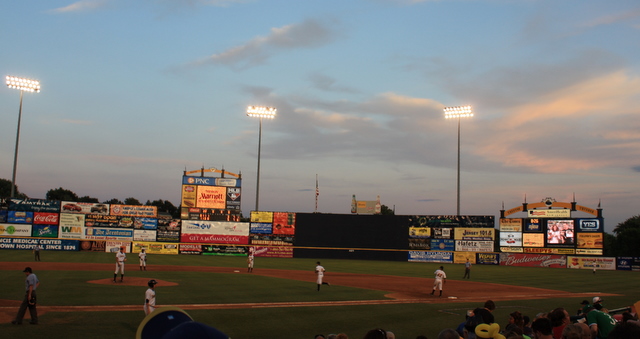
Since I love team names that feature grammar and baseball plays, what could be better than a name that puns the punctuation mark within a city’s name with the fleet-footed run from the batter’s box to first base!  The Dash.  From Winston-Salem.   Not that the team wants to flee the city or its smoky heritage, but you get the drift.  Add to that double reference the fact that the team’s name is a collective singular noun, a feature that underscores the group unity of teamwork, and you can see why I am so taken with Winston-Salem's dashing name. 
While I delight in word play about the Dash, what made the Winston-Salem game most enjoyable was that two former colleagues from Whittier, Laura Ammon and Randy Reed, drove down from their home in the mountains to join Bonnie and me for the game and dinner later in the evening.  A specialist in the history of Christianity, Laura began her association with Whittier when she was appointed to replace me during my previous sabbatical leave during the late 90s.  For several years thereafter, she continued to teach courses in religious studies while completing her Ph.D. at Claremont Graduate University.  Her husband Randy, whose expertise lies in the studies of methods and theories related to religious studies, also began to teach for us while he completed his dissertation at my alma mater, The University of Chicago Divinity School.  Incredibly, both now enjoy tenure-track appointments in the same department at Appalachian State University!
Two hours before the scheduled start of the game, violent thunderstorms rolled in and lightning struck in the parking lot adjacent to the stadium.  As the rain slackened I still needed to complete a sound check on the field, and although the violent portion of the storm had passed, I wondered whether the battery powered microphone might attract lightning. 
As skies cleared and fans began to pour into the ballpark, they were greeted by members of the Knights of Columbus who passed out small flags in honor of upcoming Flag Day.  What a great photo opportunity—a patriotic celebration by a religious group.  I reached into my computer bag for my camera and realized that it was still on the dinette table in Arby, which was docked at the Zooland RV Park 50 miles away in Asheboro. 
Although it was a Friday night, you might have thought that the ballgame in this North Carolina enclave was an ecumenical conference.  Not only were the K of C from the Holy Family Catholic Church greeting fans; according to the welcome board, there were also groups attending from 5 Baptist churches, 2 Episcopalian churches, an independent religious community, a Catholic church, and a Moravian congregation.  The series of groups could almost be sung to the tune of the 12 days of Christmas—a unifying celebration for which, like this baseball game, all of the diverse religious groups might gather together. 
Given the throng of church folk in the audience, it’s ironic—by omission—that my introduction to sing the anthem didn’t refer to the fact that I’m a professor of religious studies.  A more explicit irony was connected to my introduction.  My identification was prefaced with the sponsoring phrase: “Performing tonight’s anthem is Winston-Salem Journal National Anthem finalist and Whittier College professor Joe Price.”  What an irony!?  Several days earlier I had sent the Journal’s sports department a news release about me singing the anthem for the Dash’s game, and as usual my email got ignored, not even provoking a form reply.  Yet now, getting ready to sing the anthem, I was claimed to be a sponsored finalist for a publication that had refused to recognize the anthem performance project that I have undertaken!
For only the second time on my tour, the team made a video of my performance.  So there is some visual record of the ballpark and the Dashing fans.  (You can see it by clicking on the movie screen at the top of this page.  I always am reluctant to post the in-game performances since the acoustics at ballparks make hearing oneself difficult.)  On my way to my seat following the anthem, I was surprised by one woman’s comment, especially in North Carolina: “Thank you for not singing it country.”
The Dash’s mascot Bolt was among the most energetic and inventive on-field entertainers that I have seen in the first forty games of the season.  In one of his routines he pretended to pilfer balls from the umpire’s bag and then to pull out size 60 or larger briefs.  The crowd roared.  The underwear was so large that a later promotion could have featured a yoked race with two children using the leg holes of the underwear as waist bands to run in contrast to another pair of runners similarly tied together.  Bolt also surprised me during one of the mid-inning give-aways.  While I was talking to Randy and Laura, he threw a soft souvenir ball toward me.  Bonnie said, “Look!”  I turned, and with instinctive reactions uncommon for me, caught the spongy, small ball, a first for the season!
As was the score:  The Wilmington Blue Rocks dashed Winston-Salem’s hopes for starting their home-stand with a win.  Swatting five of their six hits for extra-base, including a couple of homeruns, Wilmington won 4-1.

Wednesday, July 13, 2011

Shots Abounding and Resounding: Game 61 in Lowell

The association of shots with baseball usually means that jiggers of whisky are somehow involved.  But in Lowell, Massachusetts on the evening following July 4, the shots that resounded throughout the evening were from muskets fired by fans dressed as Colonial soldiers from North Middlesex County. 

Minutemen load their rifles.

Often throughout the Spinners’ baseball season, these minutemen present the colors at the beginning of games.  Because their flag bearer did not arrive on time, Courtney, a staff intern with the Spinners, volunteered to carry the flag.  Yet her presence seemed incongruous even though she bore the colors.  The men carried guns; she carried the flag.  The men wore costumes from the 18th century; she wore shorts and a Spinners’ staff T-shirt from the 21st century.  Following the anthem they fired their muskets in salute; she winced at the explosion.
During the game they also fire their arms when Spinners cross home plate.  With the Spinners scoring eleven runs in the seven-inning first game of the double header, the minutemen were hardly able to reload their muskets fast enough to shoot again.
Smith takes mound for first pitch.
Despite the frequency of their firing, the musketeers were not the main shooting attraction of the game.  The Human Cannonball—David Smith, Sr., who holds the world record at more than 201 feet of cannon projection—became the first “Human Homerun.”  The promotion had been feted in ads and blogs and media in days leading up to the event. 
When I had first learned of the promotion, I had hoped to see a cannon placed in the batter’s box and a stunt man then propelled over one of the outfield fences.  Even at a cozy ballpark like the one in Asheville where the distance down the line was less than 300 feet, a human homerun would have bettered the world record more than 50%. 
I was a little disappointed, then, when I saw that Smith’s cannon was rolled to an outfield position about half-way between second base and the right centerfield wall.  When a nearby kid watched the Spinners’ staff member place a tarp to protect the field while the cannon was being rolled out, I heard him muse, somewhat prophetically, “What’s the worst thing that could happen? Damaging the field?”

The cannon is rolled to its outfield position.
No. We all knew that the worst thing might be that Smith could hit the outfield wall head-first, or that he’d land in the trees, or miss the acrobats’ net beyond the outfield wall.  Yet what appeared to be of great concern to the Spinners was the condition of the outfield grass.


Because his son who had been scheduled to be the first Human Homerun had withdrawn from the production a few days earlier, the senior Smith, age 69, inserted himself into the event.  He climbed into the barrel of the cannon, and after a launch-like count-down, he was shot over the fence. 


The spectacle was incredible.  The crowd oohed and aahed, cheered, and applauded. 
And after emerging through the outfield fence like an astronaut coming into view after a Shuttle landing, Smith waved to the fans and began a victory lap toward home.  Stopping at first base, he was interviewed about his experience of flying over the fence.  
Excerpts: "What does it feel like when you're up there?"  "It feels free." 
"How did you get started as a human cannonball?  “I was a school teacher,” he said, “and that was too tough!”
While athletes often use interviews as a means to offer a brief testimony, Smith used a different vehicle to express his faith.  He let his powerful cannon speak.         
Indeed his feat of clearing the right field wall—and the row of trees behind it—was spectacular.  A(A local news video can be viewed HERE.) Even ESPN had taken notice.  Thomas Neumann, one of its on-line editors, attended the game to document the event. Having arrived early enough to catch the first game of the double-header (unlike most of the fans), Thomas also caught my anthem rendition, interviewed me during the middle innings, and blogged his story by the following afternoon. 
The trophy case of Lowell bobble-heads.
The Lowell franchise is well-known for its creative promotions.  Over the years it has been celebrated for its unusual bobble-head give-aways, one of the most famous being its image of Jack Kerouac, an example of which is archived in the Baseball Hall of Fame. And when Jonathan Papelbon, now the ace closer for the Red Sox, was recognized with his own likeness, fans lined up for blocks before the front gates opened.  In some way, the bobble-headed feature is expected to evoke fan devotion to the Red Sox, Lowell’s parent club, or to Massachusetts.  Unusual selections joining Kerouac included a piece representing Stephen King a base identifying his three favorite novels: The Dark Tower, The Dead Zone, and The Green Mile.  (Note: this bobble-head--with head still attached--was distributed on Friday 13th!)  And a bobble-head of Emeril Lagasse, a Massachusetts’ native, was given out on the day that Katrina struck New Orleans.  (I wonder if his image came with a sound chip exclaiming “Bam!”)
In a way the Lowell ballpark seems to typify the democratic identification of a community with a team, not merely by the inclusion of Massachusetts notables in the series of souvenir bobble-heads but also by the design of the grandstands.  There was little distinction in viewing angle or closeness to field between the box seats and general admission; and there were no elegantly appointed luxury boxes atop the stadium or at dugout level.  Instead, the VIP suites were a couple of rooms adjacent to the press booth and accessible from the concourse level.  The named one—a Yawkey suite, of course—had no one in it during the first game of the evening, other than a staff member seeking quiet to finish her work or text friends.
After Smith, who was wearing Spinners number 37, had soared over the fence, the pitching coach for the Spinners, also wearing uniform number 37, looked up at me in the right field stands and said, “Are you the guy who sang the national anthem?”  I nodded yes. “Aren’t you from Whittier, California?”  Again, yes.  “Didn’t you sing last year at Fullerton?”  An affirmative trifecta!
Pitching coach Paul Abbott of the Lowell Spinners had heard my introduction and made the association of my singing with last year’s rendition for the Orange County Flyers, an independent minor league team in the Gold Coast League.  Having been in the ballpark in Fullerton that afternoon, he had heard the introduction of me as a professor at Whittier College.  That info bit stuck.
Still I wondered why Smith had worn the pitching coach’s number as the uniform when he became the first Human Homerun:  Wouldn't identification with the pitching coach suggest a strikeout possibility?   Shouldn't he prefer  a powerful slugger's number?  Wouldn't a homerun embarrass a pitching coach? 
The game’s homerun power was provided by Seth Schwindenhammer (whose surname has the most letters of any I have encountered this season).  In the fourth inning, Seth blasted a grand slam homerun, prompting shots by the Middlesex militia and propelling the Spinners to an insurmountable lead against the Connecticut Tigers.  Final scores: Spinners 11, Tigers 7.  And Smith, Sr., 1, Smith, Jr., 0.

The Spinners' ballpark--site of the NYP League All-Star Game.


Tuesday, July 12, 2011

Beating Derek Jeter: Game 59 in Trenton

By one game I beat Derek Jeter to Trenton and missed seeing him on his rehab assignment for the next two games.  As the Yankees AA affiliate in the Eastern League, Trenton is a frequent final stop for players recovering from injuries and preparing for return to New York’s active roster. 
Minor League ballpark troubadours Mike and Joe.
Although I didn’t get to sing for Jeter this time, I did get to meet and greet Mike Nolan, an affable Thunder usher who, after hearing my introduction and rendition, requested that I come to his section to talk for an inning or two.  For the past four years, Mike has been pursuing a goal of seeing a game in every professional ballpark in the country.  His current tally is 166, and he’ll add to that number in a few weeks when he makes a trip to the upper Midwest.    
Mike is examining the multiple attractions and passions that lure fans to baseball games.  He estimates that at minor league games about 10% of the fans are die-hard devotees to baseball.  So, he wonders, what prompts the majority of attendees to the ballgame and ballpark? 
Thus far, his favorite ballparks are classified by level.  In AAA he prefers Durham’s bullish image and Memphis’ urban landscape (as well as the wafting smells of barbecue from nearby Rendezvous Restaurant).  In AA he likes Altoona with its roller coaster backdrop and Jacksonville where he learned the ballpark’s ins-and-outs from the head groundskeeper.  And in Class A—well, before we got around to discussing his selections for that level, we were interrupted by fans needing to be seated in his section.  I’m sure that we’ll continue that conversation later this month when we meet up in Columbus and Indianapolis for two games when our project schedules converge.
Trenton's ballpark also deserves accolades on Mike's list.
While it was fun to make a new friend at the ballpark, it was so much more enjoyable to share the experience with long-time friends Jerry Fiddler and Missy Alden.  Twenty years ago we had met on an educational technology tour that Bonnie and I had made to the Soviet Union.   An odd thing on that trip:  we went to the USSR and came back from Russia.  Although we didn’t cause the Soviet coup and the dissolution of its republics, we arrived in Moscow at dawn, disembarking from the overnight train from St. Petersburg as tanks rolled into Red Square. 
While we bonded during the two weeks that we spent working with Russian physicists and educators, we have enriched our friendship in decades since.   We have visited in each other’s homes, we have convened at ed tech meetings, and we have sailed together in the San Juan Islands.  Missy and Jerry have also attended games in Oakland when I have sung there. And Jerry, who studied music composition before becoming a computer programmer and co-founder of Wind River Systems, has made two visionary presentations to Whittier College faculty and students about technologies’ impacts on—and possibilities for—liberal education, organizational structures, and economic and environmental sustainability.
Jerry captured me exercising.
When we had arrived at the ballpark, Jerry accompanied me to the green room where I could warm up.  And incredible though it now seems to me, I let him take photographs of me doing some of the odd facial exercises to loosen up before singing scales and a “vowels only” run through the anthem.   As wild and weird as my exercises might seem, a funny thing also happened to Jerry before we left for the field.  When Chad Heidel, my contact with the Thunder, came to get us, Jerry bumped the phone on the table, and it rang.  No one was calling—but the jostle of the Nortel phone had caused it to ring.  What was funny?  Jerry laughed: “I wrote the software for this phone.”  Then while he pressed other buttons and reset the receiver, he quipped that he must have left that sequence out of the program!
My anthem performance was among my best of the season, and I am sure that luxury of sharing a few days with good friends put me in an upbeat state of mind.  Natalie, one of the fans near our seats, observed, “I could see the joy of the anthem come through when you sang.”  She inquired about the tour, places where I’ve been, and destinations in the coming days.  As I turned back to my seat, she calmly and compassionately said, “Grace in your journey.”  While many have commented along the way about  the challenges of travel, she’s the first to speak with the intonation of a blessing.
Jerry frames my rendition with the flag.
Others also expressed appreciation for my singing enthusiastically, especially at the start of the patriotic holiday weekend.  Stephen, another fan, approached and asked if I had sung in the anthem in the key of G.  “Close,” I replied.  “Although I occasionally sing it in that key, tonight I sang it in F-sharp.”  Since he teaches orchestral strings, specializing in bass, he expressed particular appreciation for the lower register in the descending triads in the first few lines of the tune.  He said that as a baritone he was delighted to hear the rendition in a lower key.  At various times on the tour, I have been asked for my autograph.  Stephen was the first person to ask to be photographed with me along with his fiancée.
To say that it was a wild night at Trenton’s ballpark would be an understatement.  The ballpark’s tributes featured a wild disjunction of sorts— a memorial to a Red Sox All-Star seemed to hover over Yankees’ prospects.  Featured on the face of the press box directly behind home plate was the retired number 5—not for the parent Yankees’ Dimaggio but for the former Red Sox favorite Nomar Garciaparro, whose name also appeared there.  Garciaparro, who had grown up and played Little League ball in Whittier, had played for the Trenton team when they had been affiliated with the Red Sox.   
Lisa and her Havanese Elvis.
A temporary wildness of sorts also characterized the evening.  Dogs were everywhere.  They had been admitted on leash as a project to raise funds for a charity. For every dog that entered the park with its owner, a donation would be made.  Seeing all of the friendly dogs (except for one yappy Chihuahua mix), I realized how homesick I was for my dogs Winston (a three year-old Havanese) and Tucker (a year-old Cockapoo).   So when I saw Lisa and her ten-month-old Havanese named Elvis, I went wild taking photographs. 
And the outcome of the game was also largely determined by wild Thunder--at least their pitchers' lack of control.  Although the Curve hadn’t won in the dozen days since I had sung for their home game in Altoona, they didn’t act Thunder-struck this night, using six walks, three hit batters, and three wild pitches to supplement their hits en route to a 10-5 thumping of Trenton.


Monday, July 11, 2011

Searching for a Key in Frederick


Last year after I became aware of the gravesite memorial to Francis Scott Key across the street from the Frederick Keys' ballpark, I made sure that my travel schedule would permit me to spend some time there.  Early on the date of my scheduled singing for the Keys, I drove Toad (our towed car) to Frederick to have ample time to explore the tributes to Key.  


A statue of Key stands tall at the entry to Mount Olivet Cemetery, and behind the figure is a small stone chapel erected in 1911 and named in his honor.  Inscribed on the bronze plaques around the base of the statue are the four stanzas of his poem, as well as a bronze relief of the first bars of the chorus in its most popular key of B-flat.   To make sure that all entrants into the cemetery know whom the statue represents, his name is sculpted in the hedge at its base.

The information that I knew about the composition of the poem can be summarized in a few sentences.  After watching the bombardment of Ft. McHenry by British war ships during the War of 1812, Francis Scott Key, a lawyer and occasional poet, wrote the four stanzas of “The Defence of Ft. McHenry” on September 13-14, 1814. Although the poem celebrated the courageous persistence of the American forces and their flying of the stars and stripes in the face of the British onslaught, the words became aligned with a British fraternity’s drinking tune known as “The Anacreontic Song,”  whose melody was already popular in American pubs. 
Frankly, I had wanted much more information—some participatory experience, some meaningful site to see, or some artifact to examine.  While a few of those pieces of material culture are in the Smithsonian, there is relatively little in the city of Frederick.  Its Welcome Center provides minimal information about Key in a small exhibit that also celebrates two other notable Frederick residents during the 19th century, Barbara Fritchie (more below) and Elizabeth Ann Seton, the first American born Christian to be canonized by the Roman Catholic Church.  Although there were houses in the community associated with these women, I was surprised that there was no museum or marker for Key other than the memorial in the cemetery. 


Flag behind Fritchie memorial.


Well beyond the entry to Mount Olivet Cemetery, a memorial to Barbara Fritchie (the preferred spelling of her name) features the lone American flag in the park.  (Since the flag at Ft. McHenry had inspired Key to write the poem, I had hoped to see a majestic flag as part of his memorial.)  A friend of Key who participated with him in a memorial service for George Washington, she is best known, however, for being the focal figure in John Greenleaf Whittier’s poem “Barbara Frietchie’s Defiance.”  Of course, since Whittier College is named after the poet and calls its teams the Poets, I couldn’t help but be engaged by the tribute to Fritchie, who, failing Whittier’s imaginative work, likely would have been little celebrated.
Although Whittier was the most popular American poet during his day, his literary reputation is now far superseded by his contemporary Walt Whitman.  Whittier’s stature today rests more on his outstanding work as an abolitionist than on his talent as a poet.  Featuring Fritchie’s act of courage in the face of Confederate advances, his poem tacitly embraces his strong abolitionist sense while it exercises a good bit of poetic license.  Although the Union flag flew at her home and was likely riddled with holes from the mini-balls fired by Confederate soldiers, Fritchie actually lay sick in bed throughout the day of the fighting featured in the poem.  Several of the couplets capture the heart of Whittier’s spirit of protest.
Up rose old Barbara Frietchie then,
Bowed with her fourscore years and ten;

Bravest of all in Frederick town,
She took up the flag the men hauled down;

In her attic window the staff she set,
To show that one heart was loyal yet,

Up the street came the rebel tread,
Stonewall Jackson riding ahead.

Under his slouched hat left and right
He glanced; the old flag met his sight. .  .  . 
 
She leaned far out on the window-sill,
And shook it forth with a royal will.

'Shoot, if you must, this old gray head,
But spare your country's flag,' she said.


Providing individual tributes to Key and Fritchie, the cemetery in Frederick also commemorates the collective service of Confederate and Union soldiers, especially those who died in the nearby battles of Antietam and Monocacy.  The inscription on the Confederate soldiers’ memorial incorporates better poetry than the verses by Whittier.  Three panels on the obelisk present elegiac sentiments by Sir Walter Scott (the opening lines of “Soldiers rest! Thy warfare o’er”) and Alfred Lord Tennyson (lines adapted from the final verse of his “Ode on the Death of the Duke of Wellington”).

              Soldiers rest!  Thy warfare o’er,
              Sleep the Sleep that knows not breaking;
              Dream of battlefields no more,
              Days of danger, nights of waking.

              Their praises will sung,
              In some yet unmoulded tongue,
              Far on in summers that we shall not see.

              To the unknown soldiers whose bodies here rest.
              We cannot inscribe their names on tablets of stone
              But we may hope to read them
              on a purer and unchangeable record.


Flag flying in tribute to Confederate soldiers.

As moving as the sentiments on the memorial were, I felt some dissonance standing there, even with my Southern heritage.  Adjacent to the representative figure of a Confederate soldier was a flagpole hoisting his battle flag. At the very least it was somewhat ironic that when one drives immediately beyond Key’s memorial into the cemetery, the only flag that can be seen is this one of the Confederate States of America. 
Although the Stars and Stripes had occasioned the composition of the two poems—“The Defence of Ft. McHenry” and “Barbara Frietchie’s Defiance”—the flag of another aspiring nation flew more conspicuously than the American flag by Fritchie’s memorial.  And while the flag of the Confederacy at best represents the period of history during which the Southern soldiers had served and died, the flag at Fritchie’s tomb was the current version with fifty stars, not a replica of the flag that might have flown in front of her house during the 1860s.


Tombstone of Navy veteran Sonny Blank faces ballpark.


Enriched and perplexed by the history commemorated in the cemetery, I turned along Mount Olivet’s outer drive facing the ballpark.  And there I found baseball insignia on two tombstones facing the stadium.  In an odd way these two grave markers seemed to provide an effective transition for me from considering the moral and political significance of Key, Fritchie, and the war dead, to appreciating the playful spirit by which two baseball fans wanted to be remembered.

Keyed Up: Game 55 in Frederick


A key to the city and a key to the fans' hearts.
 When I first contacted the Frederick Keys a year ago, I had not realized that that their name refers to the author of the stanzas of “The Star-Spangled Banner.”  In his response to my query, Keys’ general manager Dave Ziedelis let me know that Francis Scott Key’s burial place was across the street from the ballpark.  Then I understood.  Keys: A plural noun to identify the team of Frederick players with the poet.  The name enjoys a musical ring since it often matters in which key to sing the anthem so that its wide range can be scaled.  And the puns extend to the ballpark art.  Greeting fans inside the main gate is a model of the key to the City and/or baseball's key to their hearts!

At the Will Call window where I picked up my tickets, Cheryl McClain was delighted to learn about my singing the anthem.  She related that in the 1980s, she had sung the anthem for the Keys when they had played at the old ballpark.  A special memory of that occasion was that her grandfather, “a war veteran and an avid baseball fan,” had been there to celebrate the occasion with her.  He had introduced her to baseball, which she has enjoyed ever since.  Now working for the Keys, she is pleased that her daughter Melissa is scheduled to sing the anthem for the Keys later this season, as she had done last year, as well as for the Delmarva Shorebirds, the team near her home.  When I asked Cheryl if she had been more nervous when she had sung or when her daughter had performed, she replied quickly, “That’s easy.  Hers!”
Joining Bonnie and me at the ballpark were Alan and Sandy Yamamoto, friends from Alexandria, Virginia who had been hosting Bonnie for a couple of days while I had traveled across Pennsylvania and into New York to sing in several ballparks. Bonnie has known Alan since her high school years in Watsonville, California, and our friendship has spanned the continent.  When he had been in law school in the Cleveland area, Alan had driven down to Louisville to attend our wedding, and during our visits to Washington, DC during the past two decades, we have frequently stayed with Alan and Sandy and their lovable labs.  (I miss my dogs!) 
On one of our trips to the area a dozen years ago, the four of us celebrated one of Bonnie’s teaching awards with an extravagant culinary event—having dinner at the Inn at Little Washington, then rated as the favorite restaurant in the nation by award-winning chefs.   And when I first had sung for the Orioles in Camden Yards several earlier, Alan and Sandy had driven up to Baltimore to link up with us for the game.  It was a delight to share another evening of baseball with them.  Among the varied topics of our conversation throughout the game, Alan and I dissected the placement and possible effectiveness of the 80 billboard ads—often triple-decked—on the outfield fences.
A new friend also found us at the ballpark.  Paul Lasky, who had sat in the row in front of Bonnie and me a week earlier in Hagerstown, came to the Frederick game to enjoy another night of minor league baseball.  His nephew Bret Lasky is the radio announcer for the Delmarva Shorebirds, Hagerstown’s opponent for our initial encounter.  For several innings we shared stories about baseball players and broadcast personalities, and before the evening was over Paul initiated a chance for me to talk with Bret during our visit to the Shorebirds ballpark scheduled several days later.


The pre-game Boy Scouts parade led by Keyote, the Keys' Mascot. 
In the background the outfield fence rises high with its display of advertisements.


The forlorn, fallen hot dog.
At Frederick, like my game the night before in Bowie, troops of Scouts paraded around the field before the game and then planned to spend the night camping out on the outfield.  One result of the promotion at Frederick was the team enjoyed its largest crowd in four years with more than 9000 attending the game.  The density of the crowd was so great that the lines at the concession stands seemed to stretch farther than those at Disneyland.  They were so long and slow that we actually missed almost three innings of play while waiting to buy a crab pretzel.  "Is it standard pretzel dough twisted into the shape of a crab claw, or is it somehow filled with crab meat?"  I wondered aloud to Alan.  Alas, it was simply a long, stick pretzel with a reasonably good crab dip.  But it certainly wouldn’t rival any of the hors d’oeuvres at the Inn at Little Washington.
One effect of the long food lines was that they apparently voided the ten-second rule for at least one parent.  When Alan and I saw a child drop a hot dog near the condiment counter, we sympathized with his plight of losing dinner.    He tapped his mother on the shoulder and pointed dispappointedly to his spill. We were dumbfounded by what we saw next.  The mother finished putting ketchup and relish on a couple of hot dogs, then bent down to retrieve the fallen wiener and tuck it back into the bun--an act of hunger desperation and line-wait exasperation.


A mother "rescuing" the dropped hot dog.

While Alan and I waited for service and food, Frederick catcher Adam Donachie homered for a second time in the game even though before tonight he had not hit a homerun all season.   His RBI’s lead the Keys to a dashing 6-2 win while their highly touted prospect Manny Machado, who had been promoted to the Keys three days earlier, had an unremarkable game, hitting two ground ball outs, walking twice, and muffing a grounder that was generously ruled a hit.

Wednesday, July 6, 2011

Northern Heights: Game 60 in Burlington, VT

The Vermont Lake Monsters make their home in Burlington, which is the northern-most point in the eastern portion of my tour.  Whether it or Lowell, Massachusetts is the ballpark city farthest from Whittier might be determined by how you measure the distance—by air miles or by the most direct Mapquest route.  Whatever the case, the Vermont Lake Monsters’ game on the Fourth of July weekend made it to the peak of my trip. 
The ballpark in Burlington is one of the oldest in the nation. Of course, Rickwood Field in Birmingham, which each year hosts a single game for the Birmingham Barons, is the oldest ballpark while the one in Pittsfield, Massachusetts, where the first collegiate game was played, has been restored to host various minor league franchises over the years.  Currently, it provides the home for the Pittsfield Colonials, an unaffiliated minor league team in the CANAM League.  Centennial Park in Burlington is the oldest that provides a home for an affiliated minor league team.  The original, wooden grandstands at Centennial Park in Burlington were erected in the early part of the 20th century. 

The low clearance from the concourse to concessions indicates the age of the ballpark.
During its earliest years the ballpark served as the home for the team at the University of Vermont, and in 1955 the first Minor League team took the field.  Like other small city ballparks of the era, the section for general admission at Centennial Park doesn’t have seats, merely widely tiered concrete platforms.  But unlike the custom at Pulaski’s ballpark of similar vintage and with a similar structure, none of the fans in Burlington brought folding chairs to prop up on the wide tiers.  Instead, the fans sat on the cement, often using cushions to soften their perch.

Fans sit on the wide, hard tiers.
Centennial’s field was also distinct in a couple of ways, one affecting a possible homerun.   In dead centerfield the grounds crews’ access gate was hung about 6 inches higher than the adjoining outfield wall.  Consequently, the yellow, homerun line atop the outfield fence jutted up a half-foot in that section. 
A couple of ads on the outfield fence also were distinct, one of which signaled a different field for play and another which actually could affect on-field play.  One ad featured the logo of Facebook, inviting fans to enter its simulated space by “liking” brpnews at its page.  And another ad was ingenious in its physical presence rather than its virtual direction.  Hanging on the foul poles were banners for Fairpoint Connections, the regional telephone service.  Why ingenious?  If a ball hit Fairpoint’s sign, it would be fair.
For the final game on their home-stand on the holiday weekend, the Lake Monsters’ pre-game festivities on July 3 featured Vermont Governor Peter Shumlin, who threw out the first pitch after offering a few remarks about the significance of Independence Day, the importance of Vermont as the greatest state in the Union, and the prominence of the Lake Monsters as the best team in the league.   Indeed, at the beginning of the game, Vermont stood atop the league standings. 

Gov. Shumlin poses with me pre-game.
At Burlington, the first pitch also featured an innovative way to promote the service of a sponsor. Rather than the public address announcer simply saying that the ritual was sponsored by Brick Oven Pizza, the ball for the first pitch was delivered to the mound in a pizza box, mimicking the custom of pizza delivery. 
Moments later, I was introduced as touring the country this season to sing the anthem in as many Minor League ballparks as possible, perhaps justifying to Vermont citizens why a Californian would be on the pre-game program with Governor Shumlin.  Before he had taken the mound, we had chatted briefly about pre-game routines of throwing out the first pitch and singing the anthem.  He had heard advice about aiming high for the target since he would be throwing downhill from the mound.  And I had received instruction about the stadium’s microphone idiosyncrasies. 
Following my rendition, the governor said, “You hit it out of the park.  You’re a better singer than I am a pitcher!”  That was true.   Standing in front of the rubber he had thrown a 59-foot slider.  Actually, his pitch wasn’t intended to be a breaking ball.  It simply hit the dirt in front of the plate and slid past the corner.


Jerry Fiddler captured my performance for the Lake Monsters.
Even having shared the opening ceremonies with the governor, the good times that Bonnie and I enjoyed in Vermont were more personal than political.  They were rooted in good friendship.  A couple of days before the Burlington game, Jerry Fiddler and Missy Alden, whom we had met on an educational technology tour to the Soviet Union twenty years earlier, joined us in Trenton and accompanied us in Arby for a couple of days as we trekked north.  After docking Arby in Brattleboro at a site run by one of Jerry’s cousins, we drove Toad on to Royalton to Missy’s family’s retreat atop a mountain where we spent the night.
There on Sunday morning before departing for Burlington for the afternoon game, thunderstorms rolled across the mountaintops and echoed through the valleys, and the rain run-off sluiced through gullies in the dirt road that descended from the Aldens' house toward the White River.  While we drove through residual showers en route to the ballpark 75 miles north, we monitored the weather forecast, which continued to call for showers until evening.  Thankfully, the rain stopped, billowing clouds appeared in the clearing sky, and the game proceeded on schedule.  
When we had arrived at the ballpark, Vermont’s Assistant GM Joe Doud greeted us, introduced us to other staff members, and showed us the ballpark’s “ropes”  while we talked about the anthem project. During the scheduling phases of my project, Joe had distinguished himself as one of the most communicative staff members with whom I have had contact.  Indicating that he was attracted to the project when my initial email came to his attention last summer, he said that he was overjoyed that the date that we could coordinate would be on the weekend of July 4, a time for celebrating freedom and unity, especially by featuring a special anthem performance. 
The antics of the Lake Monsters’ mascots added to the fun of the afternoon.  A new mascot, Chippy the Chipmunk, was making his debut this season to complement the actions of and attraction to Champ the Lake Monster, who has been a local celebrity for a number of years.  Chippy’s featured activity was leading kids on a run across the outfield before the bottom of the fourth.   While the visiting Tri-City ValleyCats were making their between throws, the children chased Chippy along the edge of the outfield grass from the third base line to first.

The door is open to Chippy's dressing room.  Perhaps he'll get a promotion as his popularity rises to rival Champ.
Champ’s efforts were even more energetic than those of darting Chippy.  When the Lake Monsters put runners on first and second, Champ climbed atop the ValleyCats’ dugout and began to lead a cheer for the home team as only a mute mascot could do.  Using his clown-oversized shoes, he stomp stomped the top of the dugout, followed by clap, clapping.  Again.  And again.  The crowd quickly joined in and the noise became quite a distraction to the players in the dugout, especially with Champ’s feet thudding on its roof.  Although the ValleyCats in the dugout soon surrendered, tossing out paper cups rather than waving a white flag, their teammates on the field yielded a run but didn’t relinquish the lead.
The Lake Monsters delayed their game-winning rally until the ninth inning.  Entering the frame trailing 6-3, Vermont started to rebound on an unusual play.  With one out Jordan Tripp swung and missed a third strike, a wild pitch reminiscent of the governor’s pre-game toss.  Escaping the catcher, the ball rolled toward the backstop and allowed Tripp to trip to first.  Following a walk to the next batter, two teammates singled in runs to cut the deficit.  Then with two runners on base Jacob Tanis struck out before Diomedes Lopez tied the score with a line-drive single.  Following a pitching change and yet another base-on-balls, Seth Jamieson fought off two two-strike pitches before delivering the game winning single and sending the Lake Monsters’ crowd home celebrating the holiday weekend victory.

Friendly Fans at Falwell Field: Game 46 in Lynchburg

While Wrigley Field might be known as the “Friendly Confines,” I dare say you’d be harder pressed to find a friendlier ballpark than the one in Lynchburg, Virginia, where the Hillcats (High A Class affiliate of the Atlanta Braves) make their home.   In Lynchburg Ronnie Roberts greeted me and introduced me to GM Paul Sunwall.  Both inquired about the progress of the tour and the reception that I had received at the ballparks.  I indicated that, because I sing the anthem without embellishments and at a crisp tempo, the most frequent comment is “That’s the way it’s supposed to be.”  Paul said that was exactly what he likes to hear.  Ronnie added that some audition in a traditional way, but given the microphone at game time, they try to put their own spin on it.  “They don’t get invited back,” Paul added. 
Luis Salazar laughs with coaches before the game.
Turning our conversation to baseball, Paul asked if I knew the story about the Lynchburg manager, Luis Salazar.   In Spring Training this year, Salazar had been hit in the face with a line drive that caused him to lose an eye.  By Opening Day, he was back in the dugout, and during the player introductions he individually greeted players on both teams with fist bumps.  Following and he will likely resume his position coaching third base in the second half of the Hillcats’ season.  While he has not yet taken his typical on-field position in the third-base coach’s box, it is likely that he will resume that practice during the second half of the season.   Between now and then, he’s scheduled to have advanced surgery to attach his prosthetic eye to the muscles and nerves in his eye socket, thereby aligning its movement with that of this “good eye.”
After the anthem, I exchanged several comments with Salazar. I complimented his courage and inspirational leadership and he inquired about my next few games.  Before getting to my seat by Bonnie, several fans expressed appreciation, not only for the anthem rendition but for including Lynchburg on my itinerary.  And Paul and Ronnie expressed their appreciation by introducing me to significant personalities of the ballpark.  Ronnie introduced me to Douglas Thom, a former professional light opera performer who regularly sings for Hillcats’ game.  “I heard you at the game in Little Rock a month ago when I was visiting my folks,” Douglas said.  What fun!  Four years ago he sang the anthem on the final day of Lynchburg’s season.  Given his excellent musicianship and his traditional rendition, influenced by Robert Merrill’s standard performances at Yankee Stadium where Douglas had learned to love baseball, he has now become a regular performer for the Hillcats.
Terry Falwell holds bobble-head of his father Calvin.
And Paul introduced me to Terry Falwell, son of Calvin Falwell, after whom the ballpark is named because of his instrumental role in bringing the Hillcats to the city.  Terry also happens to be the cousin of the late Jerry Falwell, televangelist and founder of Liberty University where Terry works in community relations.  Terry, in turn, seemed to know everyone in the ballpark, and after talking with Bonnie and me for a half hour about our grand adventure, he escorted us through the concourses and skyboxes, speaking to most folks by name and introducing them to us.
One was Gene Gallagher, one of the Hillcats’ owners.  Now a passionate Hillcats’ fan, Gene had not grown up loving baseball.  In fact, he had not followed baseball until his children enjoyed attending their first Lynchburg game some years ago.  After enjoying the school-night promotion on their initial visit to the ballpark, his children requested the chance to return the following evening.  They did, and Gene became a devoted Hillcats’ fan because of the family entertainment provided by the Minor League atmosphere. 
In that first season of his children’s fondness for the game and the Lynchburg team, which was then affiliated with the Mets, Gene and his family attended most of the home games and made several road trips with the team.  His eight-year old daughter Brittany fell in love with Paco Perez, one of the Hillcats’ players.  Following the final game of the year, Brittany teared up and said, “Now I won’t be able to see Paco anymore.”  Seeing her cry and hearing her remark, Paco put his arm around her and said, pointing to his head, “But you always be here with me.”  That tender moment of a Minor Leaguer’s interaction with his daughter sold Gene on becoming more involved with the team.
Now decades later Gene watched the game between Lynchburg and the Wilmington Blue Rocks with the keen eye of a businessman while cheering for the home team.   The game itself was filled with unusual plays and blown calls.  In the first inning with runners on the corners and one out, a sharp grounder was hit to the first baseman who made a strong throw to the shortstop Phil Gosselin, a fan-favorite and recent graduate of the nearby University of Virginia who was covering second.  Gosselin leaped over the sliding runner and made a strong, accurate return throw to the first base bag.  But no one covered first, the ball sailed into foul territory, and the Blue Rocks’ runner from third scored.  A group of six women behind me groaned in unison and loudly offered coaching advice to both the pitcher and the first baseman: “Come on guys.  Cover the bag.”   
Cheering encouragement to Hillcats’ hitters, gently heckling the opponent in traditional ways, and criticizing close calls by the umpires, they provided the most entertainment throughout the game. Life-long residents of Lynchburg who regularly sit in the back row of the family section, these six women had been effusive in their expressions of appreciation of my anthem rendition.  They endeared themselves to Bonnie when they pleasantly remarked to each other after the applause following my performance: “He’s traveled all the way ‘cross the United States to sing for us.”
From left: Pat Jefferson, Betty Cauley, Norma Glass, Bonnie Ayers, Nancy Trent, Delores Wright
Throughout the game, they cheered and cheered so good-naturedly that we stayed so long at the game that we almost missed our dinner reservations.  When we arrived at the restaurant quite late, the kitchen crew had already begun to scrub down the grill.  Here’s a sample of what kept us enrapt.
Responding to the Hillcats’ pitcher tossing over to first several times to keep the runner close, one who had the commanding voice of a long-term school bus driver, called out:  “Come on.  Let’s get him at the plate.”
But to the Blue Rocks’ pitcher in a similar situation an inning later, she yelled: “Forget him.  Pitch the ball.”
Encouraging a Hillcats’ batter: “Good eye, Joey.  Come on, Joey.”
Or: “Base hit, Adam.  Hit a homer.”
Advising a Hillcats’ runner on a tag play at home: “Slide.  Slide.  Slide.”
Or to the ump on a blown call: “Blue, you’re full of it tonight.”
Their remark to the home plate umpire, who surely could hear them, was only a little kinder than Terry’s comment, quoting his father: “He may have been cut out to be an ump, but somebody sewed him up wrong.”
One thing’s for sure, however.  There’s nothing wrong with a night at Falwell Field in Lynchburg.  Despite the Hillcats losing to the Blue Rocks, the fans and ballpark were simply endearing.