Monday, August 22, 2011

Westward Woe!

It’s a good thing that we had days off in Idaho and eastern Washington so that we could tend to Arby and Toad.  Although we had joyfully shouted “Westward, ho!” when, in Iowa, we turned in the direction toward home, the vehicles seemed to experience westward woe.  Both began to suffer the strains of the long trip compounded by hail storms in Wyoming, high mountain passes in Montana, and long gradual grades against headwinds in Idaho and eastern Oregon.
Following our jaunt down to Salt Lake City in Toad, we returned to Idaho Falls where we had docked Arby at an RV park near the Snake River and where, that night, I sang for the Chukars.  The following morning, we packed up as usual, emptied Arby’s holding tanks, attached Toad, and headed toward Boise, thinking that we might stop at an intermediate spot since we had an open date between the two engagements in Idaho: a final appearance with a team in the Pioneer League—the Chukars—and the first in the Northwest League at the game in Boise.
Thinking that we could enjoy the following day without any driving, we pressed on to the Boise area.  As we pulled into the Country Corners RV Park in Caldwell, Idaho, we were greeted by the owners who offered us freshly picked corn, tomatoes, green beans, and cucumbers.  As I unhitched Toad and positioned Arby in his place, I salivated in anticipation of a steamed vegetable dinner.  But as we tried to move the car into the parking spot adjacent to Arby, Toad couldn’t hop.  There was no juice left in his battery, not even enough to jump start the car, only enough to set off the car alarm, which we had not set or heard since acquiring the car.  Finally, I got the battery disconnected to disable the alarm and called AAA—the auto club, not the office of the senior minor leagues—to schedule assistance for the following morning.  Thankfully, Bonnie soothed my spirit and my hunger with the sweet corn and home-grown tomatoes.


Adam loads Toad onto the flat-bed, tow truck while Arby watches.
 At dawn the next morning, AAA arrived and after the battery technician was unable to get the car started, the tow truck was called to tote Toad to an authorized repair shop in Caldwell.  There, the diagnosis was discouraging: the day’s repairs would need to replace the battery, address malfunctions in the electrical system, replace brake rotors, service the transmission, and replace a cracked radiator.  No wonder that Toad had been running so hot!
With the repairs completed by late afternoon, Bonnie and I were able to make it to the Boise game that evening and depart the following morning for eastern Washington.  But Arby’s climb to the top of the mesas beyond the Snake River and through the Blue Mountains caused him to cough repeatedly, overheat on the ascent beyond the Columbia River bridge, and trudge up the low, long range leading to the Tri-Cities area.  Arby would need a tune-up.
With AAA’s help, we located an approved automotive shop where Arby’s issues could be treated the following morning.  So we checked into a nearby hotel, went to the game that evening, and spent our day off the following day dealing with Arby’s transfusion.
Rather than spending the two days off in the northwest writing, resting, or going sightseeing, we spent them in a pursuit that has become all too typical on our journey—dealing with automotive issues. 

Tuesday, August 16, 2011

Gene Kelly and Me: Game 84 in Des Moines

One of my favorite musicals—other than my own troubadouring of “The Star-Spangled Banner” under the stars above bleachers and near stripes of the batter’s box—is “Singing in the Rain,” especially its title song.  Even though I certainly cannot soft-shoe along the third-base line while twirling an umbrella like Gene Kelly did down the street, I joined his joyful way of singing in the rain when the Iowa Cubs hosted the Fresno Grizzlies in Des Moines. 
Still, hours and minutes before the game, I feared that my Friday baptismal jinx might prevail and that rain might prevent me from singing again.  Already during my tour, the two rain-outs had been on Fridays three weeks apart.  Since it had been four weeks since the Connecticut cancellation in New Britain, I hoped that I had broken the kind of baseball pattern that generates superstitions.  I prayed that the storm would pass over Principal Stadium in downtown Des Moines and permit the game to proceed. 
As I had sat typing in Arby at about 4 o’clock in the Yellow Banks county park 10 miles east of the ballpark, it started to rain, lightly but persistently.  An hour or so later when I began the drive to the ballpark, I maneuvered Toad around dips and deep puddles, finding that the rain had fallen quite heavily between the RV park and the stadium. 
Rain continues to splash in front of home plate in the expansive sculpture welcoming fans to Principal Park.

There also must be some connection between rain and demanding parking attendants.   At each ballpark where I have sung, parking lot attendants have granted me complementary access with one exception and one close call, both on the rainy nights when games got postponed.  This time, the situation was like that in New Britain, Connecticut.  My name was not on the Book of Life, at least for baseball games.  And since my name did not appear on the pass list, I had to fork over seven rain-drenched dollars to park near the entry.
Still the parking fee seemed worth the gamble of getting the chance to sing the anthem in Des Moines.  The rain continued steadily, even while I parked the car, walked to the Will Call window, and checked in at the Front Desk, where I heard the receptionist repeatedly begin her telephone response, saying “At this point the game is still on….”  I was relieved.  At least I kept telling myself that I was relieved.  Perhaps this evening could be like the ones in Richmond and Winston-Salem where, despite heavy showers leading up to scheduled game time, the game would go on after a short delay.


Rain continued to pool upon the tarp approaching game time.

Waiting for the rain to stop, I wandered through the concourses photographing fans and displays before I ran into a hosted party for employees, clients, and friends of DeWaay, a corporate sponsor for the evening’s game.   Permitted to join the gathering, I heard former All-Start Tony Oliva being interviewed about his baseball career and friendships.  When attendees were invited to get his autograph and/or photograph, a few moved toward the table where he sat, and I followed them. 
Once the short line had dispersed and he sat alone, I approached and asked him about memorable anthem performances from his days as a player.  He paused to recall pre-game performances of “The Star-Spangled Banner,” which, of course, is not the national anthem of his home country, Cuba.  He replied that the multiple performances by former Twins’ teammate Mudcat Grant were memorable. “Mudcat did a wonderful job,” he added.  “He’s a good singer.”


Tony Oliva and me

While most of the DeWaay party-goers talked with their friends and clients, I chatted with Oliva about baseball matters and cherished the fact that the rain that I had initially bemoaned had actually permitted me to enjoy his company. 

Before the Cuban missile crisis and its subsequent embargoes and emigration restrictions, Oliva had signed a contract with the Minnesota Twins, whose scout had recognized his quick bat and powerful swing.  After hitting over .400 in his first season in the minor leagues, Oliva progressed through the Twins’ system, tasting a cup of coffee with them during September call-ups in 1962. 

After spending the next season back in the minor leagues, he became the first Major League player to win the American League batting title and Rookie of the Year award in the same year.  Building on this exceptional start, he was selected as an All-Star in his first eight seasons, breaking Joe DiMaggio’s record streak of six.  Before being hampered by knee injuries, Oliva went on to win three batting titles and ended his fifteen-year career with a .304 average.
While sitting with Oliva, who was scheduled to throw out the final first pitch, I heard an announcement over the public address system alerted fans to the fact that, while rain was still falling and the field’s cover was being removed by the grounds crew, the game would not start on schedule at 7:05.  No new start time was then projected.  Even so, at 6:40 we watched the grounds crew turn back the tarp, surely a hopeful sign. 


The grounds crew recovers the infield as the rainfall resumes and shrouds the distant view of Iowa's capitol.

Yet within minutes the crew reversed its action and re-covered the diamond.  There it remained in place until a half-hour later when, with applause from fans and announcement that the game would start at 8:05, the crew returned to take it off the field yet one more time.

The grounds crew finally starts to remove the tarp...


...and roll it up so that play can begin.
“Home free,” I thought—as if I were scoring from second on a ground-rule double.  Instead, there was a series of 14 first pitches, the first of which was tossed by a Special Olympics participant who had taken the mound early, toed the rubber, and made repeated virtual warm-up pitches.  Following his actual lead-off toss, which hadn't crossed the plate, he didn’t want to leave his mound position until he threw a strike. 

Before the pre-game ceremony ended with Oliva’s final first toss, each of the other first pitchers was introduced before walking from the baseline to rubber, each basking in the moment as a reliever taking the mound in mid-inning.  To say the least, the ritual was protracted.  With first pitches finally finished, Iowa’s starting pitcher and catcher moved into position while drizzle continued. 


A Special Olympian strolls to the mound for the first first pitch.
Alas, the rest of team remained in the dugout while the home plate umpire convened with the grounds crew supervisor.  In the meantime, my name appeared on the scoreboard as the designated anthem singer for the evening.  The pace of the rain increased.  Nate Teut, the Cubs’ staffer who assists anthem performers and with whom I had talked about my project, wryly smiled: “83 and counting . . . and counting.”  This game would be my 84th, if ever sung.  
The home plate umpire held out his hand like the pose in Norman Rockwell’s classic painting, and catching raindrops, he summoned the Cubs’ manager out from the dugout.  He let him know that he thought that the conditions at that time were playable, but he was concerned by the report that “a yellow spot” had appeared moments earlier on the radar.  While they stood talking and while I stood waiting, the intensity of the rain increased.  The first pitches had been thrown, yet the anthem was unsung. 
Since the Iowa players would be taking the field first, the home plate umpire wanted the consent of Iowa manager Bill Dancy, who said simply, “Let’s play.”  Relieved while rain fell on me, I turned toward the flag, heard the cue of my introduction (which, by my name only, was briefer than the intros for first pitch participants), and waited for the crowd to quieten (which it didn’t).  So I started amidst the sounds of fans chattering. 
Although my performance in Des Moines was not one of my better renditions, I was still pleased that I got to sing while rain dappled my shirt and splashed my glasses.  I didn’t mind.  I was singing in the rain; and number 84 was in the books, not that anyone other than me was keeping anthem box scores.


If the rain were not wet enough, one young fan entices another to join her in the fountain sculpture.

And enjoy the dashing splashing he did!
Wet, but not soaked like the children who played in the right-field fountain, I stayed to see Justin Christian lead off at 8:06 for the Fresno Grizzlies, San Francisco’s Triple A team in the Pacific Coast League.   (Forget geography for a minute and allow the “made for Minor League Baseball reality” show that Des Moines, Iowa, which is nearer America’s right coast than the left one, competes in the Pacific Coast League).  Christian, of course, is the fleet-footed Giants’ outfield prospect who had scored from second on a deep fly to centerfield when he had been playing for Richmond on the rainy night when I had sung there six weeks earlier.  That play will certainly make my list of top ten plays during my Minor League summer.  Not to be completely outdone by his earlier performance at Double A, Christian doubled in the last of the Grizzlies' runs, who held on for a 3-2 win over Iowa's Cubs.

Thursday, August 11, 2011

Stars for the Suns: Game 48 in Hagerstown

It’s not often that you can say that a class A level team has drawing power because of a renowned player on its roster.  Players with high promise and profiles usually progress quickly to more advanced leagues.  But the Hagerstown Suns have been fortunate in their affiliation with the Washington Nationals who, because of their ineptitude on the field in recent years, have enjoyed premier selections in Major League Baseball’s drafts. 

The popularity of the Suns is suggested by the line of fans a half hour before gates open for the game.

For the first few months of this season, the Suns basked in the starlight of Bryce Harper, the number one draft pick in 2010.  At the unusually early age of 17, Harper became eligible for the draft because he had completed his GED the previous year and had enrolled in the College of Southern Nevada in order to play at the collegiate level.  There he had competed in a wood-bats league where he was named the Player of the Year while setting school offensive records by hitting above .400 and averaging a homerun every other game.  Following his incredible performance there, he signed with the Nationals.  He started this season slowly with the Suns but caught fire after getting contact lenses, and when I sang for Hagerstown he was headed to the South Atlantic League’s All-Star game as one of its leaders in batting average and home runs.
Because the weekend game between the host Suns and the Delmarva Shorebirds supported breast cancer awareness and research, the players wore pink jerseys, each of which would then be offered in a blind auction to raise money for breast cancer research.  Harper’s jersey, of course, promised to create frenzied activity and a whopping winning bid.  But Harper also wore pink shoes, the only player to be so creative.  Prior to the game, which he sat out because of a slightly injured wrist, I teased him playfully about the shoes, pointing to them, nodding my head while smirking and raising an eyebrow, and then gesturing “thumbs up.”  He smiled in return.


Harper's bid-fetching shoes.
 Following my anthem rendition, he walked to the opposite end of the dugout to shake my hand.  I felt like an all-star, even if in a league very different from his.  It also gave me a moment to share a bit of fun.  Before the game, fans had petitioned him for autographs, calling out time and again, “Bryce.  Hey Bryce!”  Each time, I instinctively turned, thinking they were calling out “Price, hey, Price,” and wondering who would be calling me at Hagerstown!  He laughed at my presumptive mis-hearing. 
The Suns’ introduction of my anthem performance mentioned simply my name, which was a bit of disappointment to several of Bonnie’s friends who had driven up from the Washington area to see the game and hear me sing.  Since they were not attentive baseball fans, they weren’t aware that they were missing seeing Harper play, especially because Kevin Keyes, his replacement in right field, hit two homeruns and a double, propelling the Suns to a 7-3 win over the Shorebirds. 
Seated near us in the grandstands was a retired couple who groaned each time the Keyes launched a shot. Paul Lasky and his wife Janet had come to the game from their home in Montgomery County to socialize with their nephew, Delmarva’s play-by-play announcer Bret Lasky.   

Jantet Lasky hugging Woolie.
 A few days earlier, Janet had retired from teaching for more than 30 years, and she celebrated her new retired freedom with another hug of congratulations from the Suns’ mascot Woolie.  When the Laskys found out that I’d be singing the following week at Frederick, Paul indicated that he’d come to that game too, which he did.  Paul also graciously set up the possibility of my meeting with Bret when I was scheduled to sing for Delmarva’s day game in late June.  Regrettably, that was one of the two performances that I had to cancel when Arby blew his alternator hours before near Farmville, Virginia.
Surprisingly, the concessions at Hagerstown offered a most extensive array of foods and concoctions than the first fifty ballparks of my season.  One stand proved particularly alluring.  It featured buffalo burgers, country ham sandwiches, and an inventive sandwich called a Roller Burger.  Richard Hollsinger, a sixth generation butcher and chef, created a rolled “hamburger” made of ground chuck, grated cheddar cheese, salt and pepper—a mixture that he then stuffed into a sausage case and smoked.  Shortly before serving, then, he grilled the Roller Burger.  Even though I have tried to minimize my consumption of ballpark foods, particularly ordinary ones, I couldn’t resist trying the Roller Burger, which was quite good: lean and somewhat smoky, with a pleasantly chewy texture like kielbasa. 
The Hollsingers also cater the meals for the Suns’ players, who favor the lasagna, pork tenderloin, and green beans.  “Green beans?” I intoned as a question. “What’s your secret?  Why do they like them so much?”  “Must be the country ham that we add to them,” Richard replied.  That’s it: green beans, Southern style.
Capitalizing on Hagerstown’s affiliation with the Nationals, another of the food kiosks featured “The All-Angus Stephen StrasBurger,” named in honor of the fastballing phenom who had set a record for initial contracts when he signed with Washington for $15.5M.  In his inaugural season with the Nationals, Strasburg suffered a career-threatening elbow injury that required Tommy John surgery and a year’s physical therapy.  Six weeks after my appearance for the Suns, he was scheduled to make his first rehab start in Hagerstown.
A third distinct concession menu could be found at Hartle’s Fry Tent, which offered everything fried except for its wings and sodas.  Hagerstown was the second ballpark where I had found fried Oreos available, and the first to offer fried Twinkies and candy bars.  About the only missing possibility was fried frog legs, which could double the fun or fear of frying by calling a single serving “A Fried Fry.”  Now if its sale could be restricted to Fridays: Okay, you can tell that my mind was about fried as I surveyed these possibilities.
For devotees, heaven might be identified as "the sweet fry and fry."
For the past thirty years, the Hagerstown minor league teams have been known as the Suns, even while their affiliation shifted from one franchise to another and while their league and level changed from Carolina to Eastern to South Atlantic.  Earlier teams in the 20th century had been known as the Hubs, the Owls, the Braves, and the Packets while the quality of teams improved from Class D in the Blue Ridge League before the Great Depression to Class B for the Interstate and Piedmont Leagues in the early 50s.
Although the earliest Hagerstown team began its play in another ballpark, it inaugurated Municipal Stadium in 1930 after the ballpark was built in 6 weeks, and all subsequent Hagerstown teams have called the stadium their home.  Before the end of World War II, the ballpark also hosted several games for Negro League teams, including the Indianapolis Clowns, the Pittsburgh Crawfords, and the Homestead Grays.  While some improvements have been made over the years, the ballpark retains its intimate and vintage character.
The historic significance of the ballpark is noted with posters of bygone teams and prominent players on walls near the concession stands.  The team also posts retired numbers above the bullpen bench, including number 24 for Willie Mays.   Although Mays never played for Hagerstown, he played his first professional game there on June 24, 1950 for the Trenton Giants, who took the field against Hagerstown's Class B Braves, then in the Interstate League.

The Suns' bullpen beneath the retired numbers.

The classic and personal character of the ballpark is displayed in multiple ways throughout the ballpark.  Near the entry to the grandstand, a white board with homey printing recognized and greeted community groups attending the game. 

The Suns' welcome board.
The scoreboard in left field is hand operated and features numbers that are hung inning by inning.  And in the grandstands, tribute is paid not merely to Hall of Fame players and historic accomplishments, a sign in front of Section C indicated that, in memory of long-time season ticket holder and devout Suns’ fan Fred Ziegler, that section will also be known as Section Z.


Wednesday, August 10, 2011

An August Slump

Like slap hitters whose legs begin to wilt and wobble in the August heat, I am certainly starting to show the effects of my long singing season.  My voice is still strong, but my energy has begun to wane.  The physical stress of the travel can be seen in my right eye, which has burst a blood vessel, and in my right thumb, injured in doing some Arby upkeep described below. 

The purple thumbnail is not covered with polish!
The hundred-degree heat in the Midwest for the last two weeks has sapped my imagination, the toll of rough roads has made Arby’s weariness an issue that requires increased attention, and the rigor of the schedule has now dumped me into a blogging slump.  Add to these woes the absence of WiFi throughout the first week of August, and the slack in my posting might be excused.   Still, as I drive each day I think about what I should write, and each evening I make detailed notes about travels and games.

But like an 0 for 19er who yearns for a dying-quail double sliced inches inside the line or a soft seeing-eye single through the hole or even a deflected drive off a diving shortstop’s glove, I needed some cheap hit, some unusual play to startle me back to my posting ways.  I had scorched some long blog drafts, but they had fallen foul or been fielded, yielding nothing to show, at least yet.
Even so,  I hadn’t expected a wind-blown error in Omaha to break me out of the blogging slump.   
After Arby had arduously trudged through the hills of western Iowa throughout mid-day, we docked in at a sunny spot atop a hill overlooking the lake at Walnut Creek County Park just south of Omaha.  Since the sun was bleating down on the bare site with a ferocity that caused high double digit temperatures to look attractive, I extended Arby’s electric awning, which had been one of our regular sources of possible comfort.  I told Bonnie that, because the wind was occasionally snapping at the canvas of the umbrella, I’d retract the awning before we left for the ballpark. 
A couple of hours later the wind gusts had dissipated, and Bonnie was snoozing so smoothly that I decided not to wake her for the game or disturb her with the sounds of the awning retracting.  As the sun shone across the horizon, I left at 5:58 for the Omaha Storm Chasers’ game less than five miles away. 
As usual, I had received instructions to check in at the ballpark at 6:30.  After parking in the distant free lot and photographing fans tailgating there, I circumvented the stadium to find the Will Call window where I expected to pick up my ticket.  


Under clear skies, fans tailgate on the parking lot a half hour before the game.
 The line was uncustomarily long.  At 6:19 I identified myself as the anthem singer, and a frenzy of action ensued.  The ticket agent called to a waiting staffer who whisked me through the gates and toward the field faster than Arby had climbed the grades earlier in the afternoon.  Because of a concert associated with a Faith Night Promotion, the start of the game had been moved up to 6:35 rather than 7:05.  I hadn’t been told.  I had 8 minutes until the anthem performance.
Whew!  I had less time to warm up than a middle-innings reliever.
When a brief rain shower sent fans scurrying to the concession concourse during the third inning, I interviewed several who clustered around me.   After a few outs, the rain eased and allowed them to return to their seats.

After the rain shower, fans start back to their seats.
Instead of resuming attention to the game, I looked toward the west where dark clouds with bolts and sheets of lightening looked more threatening than Albert Pujols stepping to the plate with bases loaded and none out in a tie game.  So I left the ballpark immediately and headed back to Bonnie and Arby.

Noting the denser storm in the distance, a few other fans precede me in leaving early.

Alas, the thunderstorm moved through the area faster than Toad could run back to Walnut Creek Park.  Alarmed by the winds’ sudden arrival, Bonnie phoned that the initial gusts had bent the awning arms before she could retract the cover.   While we talked as I started the car, the gale ripped the awning from its support, throwing its heavy roller over Arby’s roof.   Later in the evening, we learned that the winds had been clocked at 65 mph.


While this car pulled out ahead of me, Bonnie called with news that the awning had already been ripped.
 Within minutes I parked Toad next to Arby and saw that nothing could be done then about the awning which was reversed and snugged across the roof. Inside Arby, I found that Bonnie was frightened by the tempest and concerned that leaks might result from the crash that the roller bar had made when it had been torn loose from its front arm.  While the storm raged about us and rocked Arby as though we were in a row boat crossing the wake of jet ski, we considered abandoning RV life for the night and checking into a hotel, and we began to think about what to do to prepare for the next day’s scheduled journey westward toward Wyoming.  

Bonnie surveys the damage.
By midnight, the storm cells had passed into Iowa, and we slept, or at least tried to sleep.   Rising at dawn under clear skies, we quickly surmised that the awning was an entire loss: the support arms were twisted, the canvas torn, and the roller bar bent.  The entire set-up would need to be removed.  As I began to disengage the roller bar, the spring in the arm released, thwacking my thumb, which throbbed with pain as it began to swell.

Thankfully, moments later two RVers who had anchored at the park for several weeks offered to help with the removal and disposal of the awning.  Both brought tools, expertise, and energy that were indispensible.  Vern Bridgewater, who now spends winters in Alabama and summers in Walnut Creek Park, had been a metal worker and tool specialist before his retirement a few years ago.  While I unbolted the arm supports and drilled off the heads of rivets securing the sidebars to Arby, he used his reciprocating saw to cut through the final portion of the support whose complete release had been prevented by the hinges on a storage bay. 


Vern cuts the awning roller's cover.
Meanwhile, Mike Meehan, whose awning had also been damaged slightly by storm, began to cut the canvas from the roller bar.  Since he was sporting a Red Sox cap, I turned some of our conversation to baseball and the national anthem and learned that, although he spent most of his career in San Diego, he never shifted his allegiance from Boston to the Padres.  Whether wintering in Georgia or summering in Nebraska, he’s still a citizen of Red Sox Nation.

Mike hauls away the pieces.
For an hour the three of us toiled together, Vern sawing the pieces into six-foot lengths, me loading them into Mike’s van, and Mike hauling them away to the dumpster. I bid them farewell knowing that their assistance was the reason that I might keep the next engagement in Casper, Wyoming.
After a quick breakfast, Bonnie and I attached Toad to the tow bar and headed west across the recurring sameness of Nebraska’s prairie, a flat terrain across which Arby sighed in relief.

Saturday, July 30, 2011

A Quality Start Amid Base-running Blunders: Game 70 in Niles, Ohio

In baseball terms, a quality start for a pitcher means that he has completed at least six innings, giving up three runs or less, and keeping his team in the game.  Former Whittier colleague and perennial fantasy league competitor Jon Moody dubbed my anthem progress a quality start since he attended performance number 70 with me for the Mahoning Valley Scrappers’ game against the State College Spikes.  With 70 games completed and 35 still scheduled, the game in Niles, Ohio marked the two-thirds point in my project—or, in baseball terms, the end of the sixth inning.

Like me, a young fan is embraced by the Scrappers.
Call me an old warhorse or a performer from bygone years: I expect to go the distance.  I don’t see a reliever in sight, and I certainly don’t have a closer waiting in the pen to come in for the final inning—or dozen games.
If baseball metaphors apply to my anthem tour and performances, then my appearance in Mahoning Valley also was fuelled by a rally of enthusiastic reception.  Publicity about the anthem tour by Scrappers’ staff on the team’s website prompted TV journalist Dan Martin to conduct pre-game interviews with Bonnie and me.  (To see the piece that was telecast that evening on WKNB, click here.) Their respect for the project energized my anthem performance, as did the presence of Jon, his wife Jane, and his son Jonathan.
After I had sung Scrappers’ manager Dave Wallace shook hands with me, and I took the opportunity to wish him better luck than the night before when I had sung for their game in Jamestown.  That night, they lost to the Jammers 6-5 when the relief corps allowed three late-inning runs.  In response to my comment, Wallace quipped: “If we lose, I’ll hold it against you.” 

Lots of kids join in the fun, assisting a Scrappers' staffer in singing "Take Me Out to the Ballgame."
On the outfield wall in Niles, two names and numbers appeared “retired.”  One, of course, was Jackie Robinson's #42, a number officially retired from all Major League teams and Minor League affiliates, with the exception of a player (like Mariano Rivera) who was already wearing the uniform number when the 50th anniversary of Robinson’s first game with Brooklyn was reached.  The other Scrappers' number was 13, which was identified with the name “Wolcott.”  
 
Through a screen of years, Wolcott's 13 and Robinson's 42 are memorialized.
Two things puzzled me about the sign: Wolcott’s name does not appear on the roster of former Scrappers who have made it to the Majors, and the number 13, which appreared to be retired, was being worn by starting catcher Alex Lavisky.  
I wondered aloud to Jon about the conundrum and told him how in Erie a couple of days earlier I had seen two retired numbers on the outfield wall.  There I had inquired of a couple of staff members about the identify of the companion number and name to that of Robinson: “Jethroe #5.”  None knew. 
Immediately, Jon effused, “He was my favorite Braves’ player when I was growing up in Boston.  I’m not sure why, and I didn’t understand his significance until later—what he meant [as the first African-American player] for Boston and the Braves—but he was somehow my favorite.”  Sam “the Jet” Jethroe, had starred in the Negro Leagues before playing in the Major Leagues during the first wave of signings of Black players. 
In the year following Jackie Robinson's debut with the Dodgers, Jethroe also signed with the Brooklyn team and played two seasons for their Triple-A team in Montreal before being traded to the Boston Braves following the 1949 season.  As the starting centerfielder for the Braves in 1950, Jethroe made an immediate impact, hitting a home run in his first game, leading the National League in stolen bases for the season, and being named the League's Rookie of the Year--the oldest player ever to be accorded that honor.  Yes, there were plenty of baseball reasons why Jon might have identified Jethroe as his favorite Brave. 
While Jon and I caught up on each other’s professional work, it looked like the young players in the NYP League had trouble getting caught in base-running blunders.  In the first inning the Scrappers’ leadoff batter hit a routine bounder toward the second baseman.  Hitting a pebble in the infield dirt, the ball took a wicked hop and hit the Spikes’ fielder in the face, felling him and forcing his removal from the game.  
There’s a belief in baseball that a batted ball quickly finds a new fielder.  It did.  Yet seemingly oblivious to the pattern of making a miscue on the first fielding opportunity, Walker Gourley immediately made a sensational play, turning an unassisted double play in a way that I had never seen before.  The Scrappers’ batter hit a soft line drive between first and second, and the base-runner paused to see if it would be caught.  Ranging far to his left Gourley scooped the ball on a short hop while the base runner retreated toward first, trying to delay a tag to allow the batter to reach base safely.  Still, Gourley overtook him, tagged him near the bag, and lunged across the baseline to tag the batter a half-step before reaching the first base bag.
Base-running blunders continued a couple of innings later.  With Scrappers on first and third with one out, the batter hit a deep drive to the right centerfield alley.  The runner on first advanced to second, where he paused to watch the flight of the ball while the runner on third retreated to the bag to tag in case the ball should be caught.  It was. 
While the runner on third tagged and scored, the runner who had paused at second failed to return to first and instead proceeded toward third. The relay throw from the second baseman to first was fumbled but retrieved easily to double-up the runner who had never attempted retreat.

The mystifying adventures of base-running were not restricted to the Scrapper nor even the Spikes.  The umpires also  joined in their confusion.  In the top of the third with a runner on first, the Spikes’ batter hit a line drive to the third baseman who got his glove on it, juggling it up in the air a couple of times before watching it drop beyond the sweep of his bare hand.  The base umpire ruled that the ball hadn’t been caught, and the base-runner, already retreating toward first in anticipation of a catch was caught off guard.   The third baseman tossed the ball to the second baseman, who tagged the retreating runner; but his throw to first failed to beat the batter who, after crossing the bag, started back toward the dugout before being told by the first base coach to return to the bag.  The base umpire had called him safe.  Befuddled by whole sequence—as though this description might be any clearer—both runners stood on the first base bag while the plate umpire convened near the mound with the base umpire to sort things out.

Who's on first? Umpires try to solve the mystery.

The result: A double play was ruled because the home-plate umpire had had a better view of the play by the third baseman who had snagged the line drive before fumbling the ball in the exchange between his glove and his hand.  The umpires determined that the runner who had been on first had been doubled off by the tag that was applied as he had retreated to the bag.

 
Who's on first?  The umps rule "none," as Spikes manager Kimera Bartee seeks an explanation.

While I enjoyed a quality start, the Scrappers' starter didn't fair quite as well.  After a solid start, he reached his pitch count after four innings, leaving with a five-run lead.  His relievers continued to dull the Spikes until the ninth, securing Mahoning Valley's win 6-1 and preventing Wallace from holding me accountable for the outcome.


Wednesday, July 27, 2011

Doubling Up: Game 63 in Hudson Valley

Near the Military Academy at West Point, the Hudson Valley Renegades count on the availability of the institution’s staff members to work part time during the short season of the New York-Penn League.  While I am not sure if they might be considered renegade employees, I wonder if they are considered AWOL from the Academy. 
Echoing the Army's enlistment motto "Be all that you can be...," Hudson Valley encourages fans to be all that they can.
Although none of the fans at the Hudson Valley ballparks wore military uniforms or sported Army T-shirts in mid-July, it was apparent from their haircuts, demeanor (especially their crisp salute of the flag during the anthem), and conversation that many of them were affiliated with the Academy.  Rather than displaying military apparel, many fans had slipped on the Renegades jerseys given to the first 1500 entering the turn-styles.   
Since Bonnie and I had arrived at the Hudson Valley ballpark later than usual, all of the shirts had been snagged by fans who had stood in line waiting for the gates to open.  Although we didn’t get the promotional item, we were thrilled that we did receive the support of two Whittier friends who joined us for the game: Michelle Cervantes, a former student who now works in the United Nations, and Mike McBride, a colleague in political science whose campus office is almost adjacent to mine. 

Michelle warily wonders about her professors' passion for baseball.

In her work at the U.N. Michelle is responsible for coverage of the Security Council and the General Assembly.  Her duties are reflected, I think, in a job title longer than my anthem tour.  Officially, she is “The Senior Policy Coordination Assistant for the New York Office of the United Nations High Commissioner for Refugees.”   On occasions when she has taken flight to visit family in California, Michelle has attended Angels and Dodgers game when I have sung the anthem.
Mike, too, is a repeat attender at games for which I have sung, and several years ago he persuaded a tour guide at old Busch Stadium in St. Louis to let me sing the anthem at home plate in the empty ballpark a week before the season opened.  Amazingly, the cavernous edifice resonated like a shower stall since its empty wooden seats and concrete and steel structure reverberated my rendition.  Staff members emerged from offices to hear and see what was happening, and maintenance workers in the outfield stands paused during the anthem, applauding after I reached the final note.  As much fun as singing in St. Louis was, I don’t count that ballpark among the twenty Major League stadiums where I have sung for games.
Mike’s love of baseball rivals my own.  He regularly teaches a writing seminar on baseball history.  For the course he usually takes students to see a Dodgers’ game, and for another assignment he has them play rounders, often inviting me to join in the fun.  Mike’s devotion to the game extends well beyond his familiarity with its history and literature.  In the mid-1980s after the publication of the book about the original Rotisserie League, he organized a fantasy league for Whittier College faculty.  Now almost three decades later, he continues to compile and calculate the weekly statistics for the league.    

Wall of Fame tribute to local Hall of Famer.

In the ballpark at Hudson Valley, the Wall of Recognition features bronze plaques for two Hall of Famers from the nearby area.  Eddie Collins, who had grown up in Millerton, is ranked among the best second basemen of all time. During a quarter century playing at the keystone for the Philadelphia Athletics and the Chicago White Sox, he excelled at bat and on the base paths.  Seventeen times in his career, he stole home, and twice he stole six bases in a single game.  He and Ty Cobb were the pair of pre-eminent base-stealers in their day like Lou Brock and Rickey Henderson at the end of the century.  Also celebrated with a plaque on the Hudson Valley wall was Dennis “Big Dan” Brouthers from Wappingers Falls.  He had begun his 19-year big league career in 1879 with the nearby Troy Trojans in the National League.  During the dead-ball era, he was considered the greatest power hitter, slugging more than 100 homeruns in his career while compiling a life-time batting average of .342.
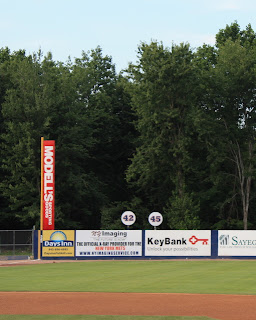
Retired numbers displayed above left field.
On another wall adjacent to the main gates, ten members of the Professional Baseball Scouts Hall of Fame are similarly recognized with plaques about their respective careers.  A different wall tribute of sorts is accorded to two players whose numbers are retired:  Circles with the numbers 42 and 45 peer like binocular lenses above the left field fence.  Of course, 42 has been unilaterally retired by Major League Baseball as a way of recognizing the contributions of Jackie Robinson.  “But 45,” I wondered aloud to several staffers who didn’t know.  Finally I learned that it was the number of Kevin Brown, the first Hudson Valley player to star in the major leagues.
The walls in a more private area of the ballpark also provide an opportunity for displaying baseball themes, not in tribute to bygone heroes but in a playful effort to appeal to the youngest possible fans.  Because I often have found that the quietest, out-of-the-way space to warm up at ballparks is in the family restroom, I was able to see the multiple murals of animals playing baseball on the walls of the family restroom at Hudson Valley.  While other ballparks have provided diaper-changing tables in their facilities, none had been as inviting as this one.

Two of the baseball murals around the diaper changing station.
Off the walls, the ballpark at Hudson Valley was also distinct, offering several unique concessions.  The healthy choices exceeded those at several other ballparks, adding gluten free beer and a tastefully named sandwich, the Thai Cobb Veggie Burger.  And the grill-to-order stand continued the playful approach to burger names, calling its monster sandwich the Eben Burger, in honor of the team's general manager Eben Yager.   The Eben Burger, which is still subject to modification according to Eben himself, is even bigger than most at McDonalds:  It is a freshly grilled half-pound hamburger stuffed with cheddar cheese and A-1 steak sauce. 
While I salivated for either of these burgers, I knew that I couldn’t eat it before the anthem.  At 6:25 participants in the pre-game ceremonies were called to the first base dugout, and I joined the throng.  In contrast to the confined space at New Hampshire on the previous night where theater chains had cordoned off the place for pre-game participants to stand until time to fill their roles, the area in front of the Renegades’ dugout almost looked like a flash mob scene, especially since 53 young ballet dancers in pink and maroon costumes clustered there.   Add to these performers the score of their parents wielding video cameras, the dozen softball players awaiting introduction, and the usual cadre of Little Leaguers ready to take the field with the starting line-up, and you can see why it was almost as crowded on the field as in the grandstands.

The pre-game ballerinas begin to process in front of the Renegades' dugout.

Inspired by the ambiance of West Point and the presence of good friends, I sang about as well as possible; and my rendition was enthusiastically embraced by the crowd, which respected the anthem with impeccable protocol.  I was surprised, however,  by one of the fan’s response.  While returning to my seat, one woman stopped me and said, “Thank you.  You sang it better than the people who were born here.  You’re a foreigner, aren’t you?” she continued.  “You sing with an accent.”  “No ma’am,” I replied.  “I grew up in the South, but I try to sing crisply and pronounce each word clearly.”
A few days earlier at another ballpark a person had asked if I were Scottish because of the roundness of my vowels in “the dawn’s early light.”  I guess that my attempts to articulate each word clearly disguise my Southern accent.
For the most part, the game itself was a rather ho-hum affair.  Both teams scored a single run in the first few innings, and then matched records through regulation: one run on three singles and one error, apiece.  But there was a twist to the action in the sixth when Renegades’ pitcher Mickey Jannis, who had entered the game at the top of the inning, gave up a questionable single, a misplayed soft line drive that glanced off the second baseman’s glove.  An odd sequence then developed.  Jannis approached the foul line where he was met by the trainer, manager, catcher, and umpire.  It didn’t look like he had hurt his arm or leg since he didn’t try to twirl his arm, rub his leg, or flex his knee.  Pausing at the first base line, he simply left the field and went into the dugout; yet the manager and umpire summoned no new reliever. 
A few minutes later Jannis returned and started toward the mound but turned back, calling for the trainer to supply tissue for his nose.  Apparently, he had a slight nose bleed and tried to stuff tissue into his nostril; but the home-plate umpire seemed concerned about the possibility that the white protrusion from his nose might distract the hitter.  Back to the dugout he went.   After a twelve-minute delay, he finally resumed pitching, missing the strike zone on his first two offerings before getting the batter to ground into an inning-ending double play.
Following the ValleyCats’ futile turn at bat in the top of the seventh, I lead off the traditional mid-inning stretch by singing “God Bless America.”  In anticipation, players emptied from the dugouts, lined up and toed the grass, took off their caps and held them at their side or dropped them by their shoes.  They placed their hands over their hearts as though they were pledging allegiance to the flag.  Impressed by their reverential respect for the song by Irving Berlin that Kate Smith had popularized, and inspired by the presence of friends and the proximity to West Point, I doubled my singing pleasure of the evening. 
With the score knotted 1-1 in the bottom of the 8th, fans along the third base line tried to rally the Renegades by starting a wave.  It didn’t work—neither the rally nor the wave.   But in the 10th inning, the Renegades scratched out a run on Chris Winder’s single and stolen base, followed by his advance to third on a ground out.  With two outs then, he scored the winning run on a wild pitch. 
For the second time in a week, I watched the Valley Cats suffer a walk-off loss on a battery muff: a dropped third strike in the ninth had led to their defeat in Vermont, and now the extra-inning wild pitch in Hudson Valley allowed the Renegades to double their score: Hudson Valley 2, Tri-Cities 1.
All in all, it was also a kind of Wrigley-esque evening of doubling my pleasure and doubling my fun by singing twice and sharing the game with Whittier friends.